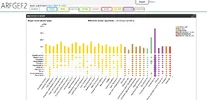
There's one SNP that immediately stands out to me: chr20:48914264 TTGC>T.
Yeah I think that's quite possible, it has the second largest probability (PIP) in SUSIE.
Below are the 12 SNPs that carry 85% of the probability. The two most likely candidates are those at the top because (1) they have the largest probability and (2) they are the only ones that are insertions and deletions which likely has a bigger effect in introns that a mere DNA letter change. They are both are quite common mutations with a minor allele frequence around 30%.
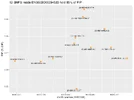 The top hit
The leading SNP is the one with the smallest p-value in DecodeME. Here an A is added to position 48914387 on chromosome 20. It’s pretty close to the splice region, the shift from intron to exon.
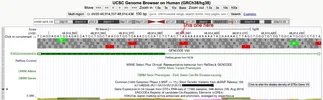
But my understand is that adding an A here would have little effect. Because this RNA gene is read from the other side we have to read from right to left and switch the letters. So, it basically becomes an extra T in a region that already has multiple after each other as a signal that the intron is about to end. So the signal stays the same, isn't disrupted and probably won’t have a large effect.
Plus strand <-
Reference: ...CCATCTCTACTTAAAAAAAAAAATACA...
Variant: ...CCATCTCTACTTAAAAAAAAAAAATACA...
lncRNA direction ->
Reference: ...TTGTATTTTTTTTTAAGTAGAGATGG...
Variant: ...TTGTATTTTTTTTTTAAGTAGAGATGG...
20:48914264:TTGC:T
The second SNP might be more interesting. It’s a deletion the TTGC pattern becomes just a T. That TGC is part of a pattern (‘TGCTGAC’) that transcription factors MAFF and MAFB recognize and like to bind as shown below in the graph (under JASPAR database). The deletion would probably disrupt this binding.

But it is not clear what effect this would have and through which gene(s). One curious thing is that this SNP came up earlier when I tried to run them all through AlphaGenome, the Google AI model that tries to predict what mutations do. You can test their effect on multiple ‘tracks’ or cell lines. 20:48914264:TTGC:T had the biggest predictive effect, and it was linked to chromatin accessibility and active histone marks in myeloma cell lines (so cancer of plasma cells), namely:
DNase-seq - RPMI8226
DNase-seq - MM.1S
ATAC-seq - NCI-H929
H3K27ac, H3K4me1, H3K4me2 - MM.1S, KMS-11, NCI-H929
Haven’t been able to make sense out of this yet (could be a hallucination) but want to mention it anyway, in case anyone else is able to check this more thoroughly. Given the Daratumumab trial, it might be an interesting finding, but the tools are all quite new to me. Will need to digg deeper to understand them better first.