
DMissa
Senior Member (Voting Rights)
https://www.virologie.uni-wuerzburg...oup-prof-dr-thomas-herrmann-senior-professor/ look in publications list of this guyI wonder if anyone on continental Europe is working on BTNs?

https://www.virologie.uni-wuerzburg...oup-prof-dr-thomas-herrmann-senior-professor/ look in publications list of this guyI wonder if anyone on continental Europe is working on BTNs?

https://www.virologie.uni-wuerzburg...oup-prof-dr-thomas-herrmann-senior-professor/ look in publications list of this guy
I am now up to my ears in grant writingI am now up to my ears in grant reviewing

i share your sense of gravity


This guy's publications look really relevant! I hope someone can find the time to make the approach.https://www.virologie.uni-wuerzburg...oup-prof-dr-thomas-herrmann-senior-professor/ look in publications list of this guy

Fair point. I think meningeal macrophages might be most promising--at the Invest in ME conference, Maureen Hanson made a good comment that meningeal involvement (at least in the acute phase) has been observed with both EBV and SARS-CoV-2. That population seems to have a robust IFN response per the linked study, and they could easily be the link between light/sound sensitivity in regular meningitis and ME/CFS.Yes, but I think I would argue that when it comes to where the two main candidates would be around neurons again, so the same strategy as what James is looking at, or a shift in an innate immune cell population that could function anywhere so it doesn't matter too much.
Hi,https://www.virologie.uni-wuerzburg...oup-prof-dr-thomas-herrmann-senior-professor/ look in publications list of this guy

Thank you for commenting! I think this is exactly what we need. I also don’t know much about BTN, but maybe a couple people here with more knowledge can help you draft an email? I’m curious to what your PI will say.Hi,
I used to work in the virology department in Würzburg and I am still PhD candidate in the graduate school there (and I have a Uni Würzburg mail account). However I do not know Thomas Herrmann and I am not on top of the BTN topic but if you think my connections there could be useful I am happy help make contacts.
I will also ask my PI if he has collaborations with him.

end of day befuddlement... you know what I mean but I appreciate the good humour in the face of such woeful phrasingThat would be the need to lie down, in my case because of a bad back?
keep us postedHi,
I used to work in the virology department in Würzburg and I am still PhD candidate in the graduate school there (and I have a Uni Würzburg mail account). However I do not know Thomas Herrmann and I am not on top of the BTN topic but if you think my connections there could be useful I am happy help make contacts.
I will also ask my PI if he has collaborations with him.
The story is that BTNs recognise bacterial phosphoantigens. I am sceptical. I think they probably do something much more general, nothing to do with bacteria.
I think a lot of it came down to this:
"Activation of γδ T-cells can be elicited by butyrophilin/butyrophilin-like molecules that are structurally similar to the immunosuppressive B7 family members. Yet how they regulate and coordinate αβ and γδ T-cell responses remains unknown. Here, we report that the BTN3A1 butyrophilin inhibits tumor-reactive αβ TCR activation by preventing segregation of N-glycosylated CD45 from the immune synapse."
BTN3A1 governs anti-tumor responses by coordinating alpha-beta and gamma-delta T cells - PMC
Gamma delta (γδ) T-cells infiltrate most human tumors, but current immunotherapies fail to exploit their in situ MHC-independent tumoricidal potential. Activation of γδ T-cells can be elicited by butyrophilin/butyrophilin-like molecules that are ...pmc.ncbi.nlm.nih.gov
Essentially this switch is messier than expexted!
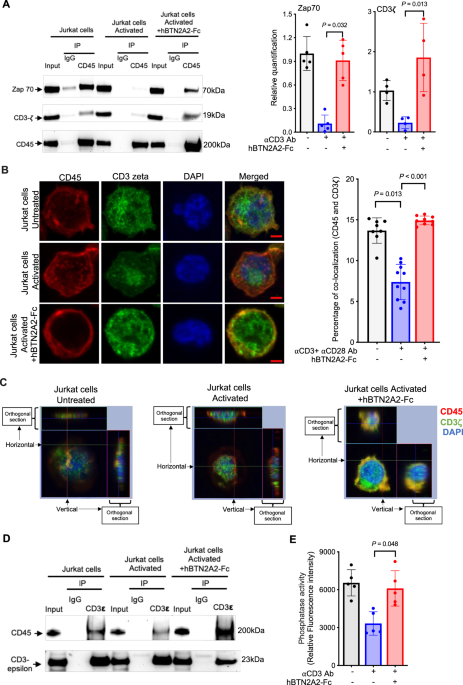
 www.nature.com
My phone is glitching. This is over my head too at present. @jnmaciuch is likely to be more on to it.Sounds ver plausible @ChronicallyOverIt
Is this a property solely of 2A2? Or could 2A1 do something like this too? Do we still think 2A1 is the most likely candidate in MECFS?@Jonathan Edwards would you take a glance at this paper I posted yesterday:
Also this paper:
Butyrophilin 2A2 promotes T cell immunoregulation via CD45 phosphatase activation and protects against murine autoimmune glomerulonephritis and pregnancy loss
Butyrophilin 2A2 promotes T cell immunoregulation via CD45 phosphatase activation and protects against murine autoimmune glomerulonephritis and pregnancy loss - Nature Communications
Butyrophilin 2A2 is a member of the B7 costimulatory family that is expressed on antigen presenting cells and is linked to the regulation of T cells. Here the authors implicate butyrophilin 2A2 in enhancement of CD45 phosphatase activity within the immunological synapse during T cell activation...
Are these BTN's controlling T-cell response via CD45? These papers are bit over my head but the gist I get is that it does not require the phosphoantigens and are basically setting t-cell responsiveness. Any chance this effects other immune cells?
The first paper you linked shows that BTN3A1 has different binding affinities and roles than BTN2A1, so unfortunately we can’t assume that any function of one BTN is shared by others.Are these BTN's controlling T-cell response via CD45? These papers are bit over my head but the gist I get is that it does not require the phosphoantigens and are basically setting t-cell responsiveness. Any chance this affects other immune cells?
Recherche sur les variants du gène BTN2A1 associés à la maladie cœliaque.
