

ME/CFS Science Blog
Senior Member (Voting Rights)
Here are the results of my brief analysis of this locus (there's more about my methods and approach in the chr20 locus).
Credible set
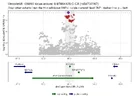
This region also had one credible set of 86 SNPs over a 180 kb. It’s in a gene desert, far removed from protein coding genes but lies in a long non-coding RNA called ENSG00000271860. It also includes another non-coding RNA called MIR2113.
Chromatin
5 of the SNPS were in a regulatory region suggesting open chromatin. The biggest effects for DNAse results were for regulatory region EH38E4411500 which contains rs756671264. The chromatin here was most open in fetal brain samples.
Another one of these regulatory regions (EH38E2487665 containing rs7753937) had 3D contacts with promotor region of several genes. POU3F2 was the only protein-coding gene. Data came from Intact Hi-C in mammary epithelial cells (MCF 10A) though, not from brain samples.

eQTL
In the more than 200 eQTL datasets I only found one with a high probability of having the same signal and it was a weak one linked with the non-coding RNA in the brain/amygdala. The ME/CFS risk allele lowers the IncRNA.

Phewas
In the Phewas analysis of other genetic studies that found a similar signal here I got peculiar results. The large analyses BMI and intelligence signals in this region give PP. H3 0.8-0.99 which suggests that their main signals are driven by different variants. There were multiple dataset that had a similar signal but I can’t really make much sense out of the results. There doesn't seem to be a clear pattern.

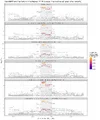
It looks like these are analyses from the the UK biobank dataset. Perhaps it points to some participation bias in the UK biobank or perhaps it’s just noise from scanning 50,000 GWAS looking for a signal. Plotting the data shows that the signal is often a bit different despite the high colocalization.
Credible set
This region also had one credible set of 86 SNPs over a 180 kb. It’s in a gene desert, far removed from protein coding genes but lies in a long non-coding RNA called ENSG00000271860. It also includes another non-coding RNA called MIR2113.
Chromatin
5 of the SNPS were in a regulatory region suggesting open chromatin. The biggest effects for DNAse results were for regulatory region EH38E4411500 which contains rs756671264. The chromatin here was most open in fetal brain samples.
Another one of these regulatory regions (EH38E2487665 containing rs7753937) had 3D contacts with promotor region of several genes. POU3F2 was the only protein-coding gene. Data came from Intact Hi-C in mammary epithelial cells (MCF 10A) though, not from brain samples.
eQTL
In the more than 200 eQTL datasets I only found one with a high probability of having the same signal and it was a weak one linked with the non-coding RNA in the brain/amygdala. The ME/CFS risk allele lowers the IncRNA.
Phewas
In the Phewas analysis of other genetic studies that found a similar signal here I got peculiar results. The large analyses BMI and intelligence signals in this region give PP. H3 0.8-0.99 which suggests that their main signals are driven by different variants. There were multiple dataset that had a similar signal but I can’t really make much sense out of the results. There doesn't seem to be a clear pattern.
It looks like these are analyses from the the UK biobank dataset. Perhaps it points to some participation bias in the UK biobank or perhaps it’s just noise from scanning 50,000 GWAS looking for a signal. Plotting the data shows that the signal is often a bit different despite the high colocalization.


