
InitialConditions
Senior Member (Voting Rights)
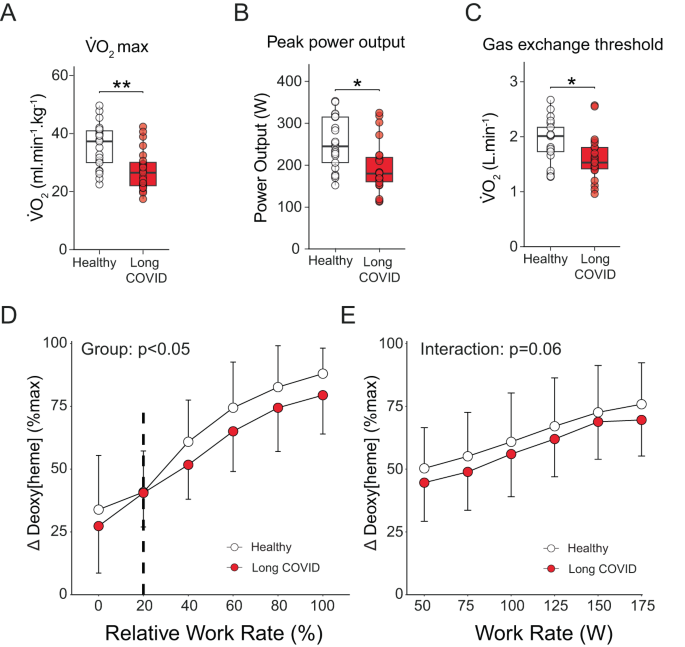
Now in press at Nature Communications: https://www.nature.com/articles/s41467-026-75725-y

I find this bizzare. I have asked Rob on Twitter whether they actively selected for LC meeting CCC, but it would not surprise me if they didn't, given their insistence that basically everyone with LC has PEM. The fact that this LC group could be considered an LC-ME/CFS group would have implications for how this study's results are interpreted.All LC patients had ME/CFS (CCC).


I find this bizzare. I have asked Rob on Twitter whether they actively selected for LC meeting CCC, but it would not surprise me if they didn't, given their insistence that basically everyone with LC has PEM. The fact that this LC group could be considered an LC-ME/CFS group would have implications for how this study's results are interpreted.
However, I was just looking at the CCC again: PEM is not actually mandatory. You can have post-exertional fatigue. I am worried that this could pick up cases of exertional intolerance, from e.g., cardiovascular dysfunction and/or dysautonomia, that isn't strictly PEM. This might explain the really high rates of PEM reported in some LC studies, including by Wust + co.
View attachment 33443


 www.nature.com
exertional intolerance
Exercise intolerance involves any abnormal symptoms during exertion, most notably fatigue, chest pain, rapid heart rate, and shortness of breath. The focus is almost always on physical exertion and it is often attributed to deficits/dysfunction of the cardiopulmonary and respiratory systems — such as those found in cardiac deconditioning — but there are other reasons why one might have exertional intolerance. Exercise intolerance seems to be very common in long covid, and is often present in non-ME/CFS LC patients.When did "exertional intolerance" become a distinct construct from PEM? And in that context, what is exertional intolerance? Just regular fatigue after exercise if you're deconditionied? When the IOM introduced SEID, I remember people mostly hated the name but appreciated that they got the PEM concept into it even though they called it "exertion intolerance." I don't remember people objecting specifically that EI was different from PEM. But maybe they did and I missed it. At the time I was mostly reading US sources.
I wrote about this here (https://bjsm.bmj.com/content/60/8/6...well-to-traditional-rehabilitation-approaches) in response to a paper by Charlton + Wust plus Putrino and Systrom, which itself was a rebuttal of an American Heart Association statement on deconditioning in long covid. I felt like an imposter writing this, but I really think this is a problem that needs addressing.Exertional intolerance involves any abnormal symptoms during exertion, most notably fatigue, chest pain, rapid heart rate, and shortness of breath. The focus is almost always on physical exertion and it is often attributed to deficits/dysfunction of the cardiopulmonary and respiratory systems — such as those caused by cardiac deconditioning — but there are a whole host of reasons why one might have exertional intolerance. Exercise intolerance seems to be very common in long covid, and is often present in non-ME/CFS LC patients.
In most of the literature, exertional intolerance and exercise intolerance would be intechangeable terms. It's only really in the ME/CFS literature where exertional intolerance (ala SEID) can mean problems from e.g, cogntive exertion.
PEM is very different. It's delayed for a start, takes much longer to recover from, and can be caused by any form of exertion. It exacerbates all existing symptoms, even those that have nothing to do with physical fitness and the cardiovascular system.
I am concerned that PEM and exercise intolerance are being confused, particularly in the long covid literature.

That is such a good response IC, well worth a read as a refresher.I wrote about this here (https://bjsm.bmj.com/content/60/8/6...well-to-traditional-rehabilitation-approaches)
Thanks @HutanThat is such a good response IC, well worth a read as a refresher.
Jo, can you elaborate? do you mean the existing usage of "exertion intolerance"?I think this may be another example, like pacing, where people in the ME/CF field have not taken into accunt existing usages of terms in other fields.
Jo, can you elaborate? do you mean the existing usage of "exertion intolerance"?


 solvecfs.org
