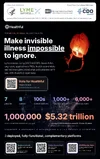
US TOPx HHS AI & Tech Sprint Update: Visit https://invisibleillness.crowdicity.com/ to register & vote for Team Healthful & $200k to support our work

Healthful_Manny

Established Member
Dear Esteemed @S4ME Members:

After engaging with this forum (please accept our sincerest appreciation), speaking with hundreds living with ME/CFS and Long COVID, and collectively spending over 1,000 human hours over the past eight weeks, our Team Healthful is proud to announce that we have developed and deployed three complementary platforms that reinforce each other to help advocate for invisible illnesses like ME/CFS, Long COVID, and Lyme Disease.

If you would like to support Team Healthful so that we can continue our work extending our work, please vote for our team:

Click Here to Register & Cast Your Vote for Team Healthful!

Registering to vote is easiest from a desktop. With a $200k win for our team, your vote could support our goals to add 7,500 points of light of lived experience with ME/CFS and Long COVID to our map of invisible illness, and extend the map globally. Separately, we also commit to delivering a 3,000-person nationally representative longitudinal cohort of individuals with ME/CFS and Long COVID to ensure that the costs and burdens are captured and seen to support further advocacy.

Your vote can and will make a difference in our ability to continue our work after the sprint, to continue to build and extend each of the three platforms below:

1) Our decision console to support national investment in Long COVID which we will extend to ME/CFS, Lyme Disease, and other invisible illnesses: Pricing the Invisible, Valuing the Cure Policy Decision Console

2) The Community-Led COVID Impact Assessment and Risk Scoring which will fill the gaps in cost and burden data to enhance (1) over time: Community-Led COVID Impact Assessment. We will create a separate Community-Led ME/CFS Assessment with your vote and a win!

3) A Million Points of Light Awareness Campaign to collect lived experience so that the qualitative experiences of individuals living with Long COVID, ME/CFS, and other invisible illnesses won't be ignored: A Million Points of Light Advocacy & Awareness Platform

If you have any suggestions or questions at all or would like to collaborate moving forward, please do not hesitate to email our team at contact@HealthfulData.com.

With sincere appreciation,

Manny & Team Healthful

P.S. If you would like to learn more about our approach before you cast your vote, you can watch or listen to this 3-minute video here.
 

Attachments

  • Healthful TOPx HHS LymeX Phase 2 Infographic 1 of 3.webp
    Healthful TOPx HHS LymeX Phase 2 Infographic 1 of 3.webp
    667.5 KB · Views: 0
  • Healthful TOPx HHS LymeX Phase 2 Infographic 2 of 3.webp
    Healthful TOPx HHS LymeX Phase 2 Infographic 2 of 3.webp
    253.2 KB · Views: 0
  • Healthful TOPx HHS LymeX Phase 2 Infographic 3 of 3.webp
    Healthful TOPx HHS LymeX Phase 2 Infographic 3 of 3.webp
    210.5 KB · Views: 0
Last edited:
Welcome @Healthful_Manny

I have had ME/CFS (following EBV infection) for over 30 years now, so presumably am not your target demographic. One thing I was thinking is that a cross sectional evaluation though obviously important ultimately will not tell us the long term costs of Covid-19. My experience was of going half time at work and gradually improving over a number of years to the point I I was thinking of returning to full time work. Unfortunately five years in, an episode of seasonal flue triggered a major relapse and I had to stop work completely. I was managing self care and daily living activities, but since a subsequent relapse nearly twenty years in I now need carers to be able to continue living independently.

I wonder if given the over lap with ME/CFS, those with non Covid triggers might offer some hints at possible long term implications of Long Covid, given that though for some improvement and even full recovery is a possibility, relapse and further deterioration even decades down the line is also possible.
 
Hi Manny!

I’m going through the survey and will write my thoughts here along the way. I’m not based in the US, so I’m assuming I’m not the target audience for the final version.

First: Please consider removing the GIF. Visually intrusive elements and ME/CFS go very poorly together. You can post the pages as separate images.

The survey is very long. The start should indicate how long and if you can take breaks in between. The more severely affected will not be able to complete it.

It asks for lots of sensitive data and it does not provide enough information about how the data will be handled and what it will be used for. You’d have major issues with GDPR if you were in the EU, and I would not be surprised if data like this would require ethical approval for a research project in the US.

Many people with LC struggle with brainfog and have limited cognitive capacity. Using double negatives in the questions is a bad design choice.

IMG_0175.webp
How am I supposed to remember what I ticked off in the previous question? Also, it should be a resizable box, not just a line.
IMG_0176.webp
Another poor design choice. Why not just use multiple choice questions with checkboxes for each option?

This is where my session stopped. I was told it had expired and I was told to log in, but I don’t have an account.

I think you intentions are good. As an economist myself I believe that demonstrating the true cost of covid will make it harder to ignore, so it’s a worthwhile effort if done right.
 
Welcome @Healthful_Manny

I have had ME/CFS (following EBV infection) for over 30 years now, so presumably am not your target demographic. One thing I was thinking is that a cross sectional evaluation though obviously important ultimately will not tell us the long term costs of Covid-19. My experience was of going half time at work and gradually improving over a number of years to the point I I was thinking of returning to full time work. Unfortunately five years in, an episode of seasonal flue triggered a major relapse and I had to stop work completely. I was managing self care and daily living activities, but since a subsequent relapse nearly twenty years in I now need carers to be able to continue living independently.

I wonder if given the over lap with ME/CFS, those with non Covid triggers might offer some hints at possible long term implications of Long Covid, given that though for some improvement and even full recovery is a possibility, relapse and further deterioration even decades down the line is also possible.
Hi! Thank you! Your point is very well taken. That is, after the Sprint, we will design for longitudinal follow-up, as risks, impacts, and costs will certainly only accrue over time, particularly as the sequelae of Long COVID have not had time to fully bear out.

I love your thought on ME/CFS as a proxy for long term implications of Long COVID. Our cost of illness model can toggle between Long COVID, ME/CFS, and Lyme Disease, therefore we treat each of these as independent, and therefore would prefer to categorize ME/CFS on its own, and have a separate analyst-adjustment for whether they would like to apply long term ME/CFS sequelae as a proxy for long-term Long COVID.
 
Hi Manny!

I’m going through the survey and will write my thoughts here along the way. I’m not based in the US, so I’m assuming I’m not the target audience for the final version.

First: Please consider removing the GIF. Visually intrusive elements and ME/CFS go very poorly together. You can post the pages as separate images.

The survey is very long. The start should indicate how long and if you can take breaks in between. The more severely affected will not be able to complete it.

It asks for lots of sensitive data and it does not provide enough information about how the data will be handled and what it will be used for. You’d have major issues with GDPR if you were in the EU, and I would not be surprised if data like this would require ethical approval for a research project in the US.

Many people with LC struggle with brainfog and have limited cognitive capacity. Using double negatives in the questions is a bad design choice.

View attachment 34607
How am I supposed to remember what I ticked off in the previous question? Also, it should be a resizable box, not just a line.
View attachment 34608
Another poor design choice. Why not just use multiple choice questions with checkboxes for each option?

This is where my session stopped. I was told it had expired and I was told to log in, but I don’t have an account.

I think you intentions are good. As an economist myself I believe that demonstrating the true cost of covid will make it harder to ignore, so it’s a worthwhile effort if done right.
Hi Utsikt! Thank you so much for going through our draft. We will absolutely incorporate every suggestion. This is why we ask for individuals to review before attempting to broadcast it more widely so we can make these types of fixes.

Indeed, if individuals are logged in, then they are able to resume from where they left off. Let me work on the back-end to extend the time-out to allow for more time to complete the assessment. One possible solution could be to simply break the assessment into two smaller assessments. Our team will think through the implications.

We would love your feedback as an economist - we have two health economists on our team, but can certainly benefit from your perspective!
 
Indeed, if individuals are logged in, then they are able to resume from where they left off. Let me work on the back-end to extend the time-out to allow for more time to complete the assessment.
Even without writing the comments here, I would not have been able to complete the survey within the allotted time. If a login is required to save the results, it should be stated clearly at the start of the survey.

I’ll see if I can give it another go in the coming days.
 
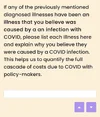
This survey is extremely duplicate. Even though I answered I can't work at all it asked several work related questions like how much pay I get or how many work hours I missed. It asked several questions that had the answer "can't work at all due to my health".


Also why does it ask for an email but doesn't allow any non-megacorp providers? Is there an invisible whitelist somewhere?
 
It would be better to have clearly labelled "Back" and "Next" buttons instead of up and down arrows.

"Please select the conditions with which you have been diagnosed by a doctor" doesn't contain ME/CFS which is odd for a long covid survey.

As Utsikt mentioned, the UI should use a regular single choice/multiple choice list. And I agree with Clio that many questions are duplicated. I hate to say it, buy it feels very amateurish. I'm not impacted by brainfog and could answer it in one sitting, but it's so clunky that I lost motivation after 5 questions. Perhaps use a dedicated survey software instead of your own frontend.
 
Even without writing the comments here, I would not have been able to complete the survey within the allotted time. If a login is required to save the results, it should be stated clearly at the start of the survey.

I’ll see if I can give it another go in the coming days.
Hi Utsikt! Thank you for your kind feedback, and sorry again about the timeout. We’ve extended the session to 30 minutes so people have more room for breaks if needed. We have also made it clearer at the start that for those who might need more time, setting up an account ahead of time allows progress to be saved. We’ve removed the .gif and a few other elements that were causing issues. We really appreciate you taking the time and I truly hope the next try goes more smoothly.

With sincere appreciation,

Manny & Team Healthful
 
This survey is extremely duplicate. Even though I answered I can't work at all it asked several work related questions like how much pay I get or how many work hours I missed. It asked several questions that had the answer "can't work at all due to my health".


Also why does it ask for an email but doesn't allow any non-megacorp providers? Is there an invisible whitelist somewhere?
Hi Clio,

This is extremely important feedback, as you're right, in seeking to quantify all the various ways work might be impacted, we neglected to have a gating function at the very beginning of our productivity assessment that negates all the rests of the questions that assess degrees of work impairment.

We will implement this and it will hopefully save time for so many.

With sincere appreciation,
Manny
It would be better to have clearly labelled "Back" and "Next" buttons instead of up and down arrows.

"Please select the conditions with which you have been diagnosed by a doctor" doesn't contain ME/CFS which is odd for a long covid survey.

As Utsikt mentioned, the UI should use a regular single choice/multiple choice list. And I agree with Clio that many questions are duplicated. I hate to say it, buy it feels very amateurish. I'm not impacted by brainfog and could answer it in one sitting, but it's so clunky that I lost motivation after 5 questions. Perhaps use a dedicated survey software instead of your own frontend.
Hi! Thank you so much for your detailed feedback, and we are certainly sorry the experience felt clunky.

We have added ME/cfs to the diagnosed-conditions list. We also de-duplicated a number of the work-related questions (and will continue cleaning up overlaps). We will work on the button UI, but that might take a bit longer for our engineering team to pull through as we are focused on ensuring that the data flows to the cost of illness model properly.

This has been a compressed 6-week sprint (2 months start to finish) as designed by HHS, so we’ve had less time for our usual QC than we would normally take. We truly appreciate you sticking with it and flagging these issues for our team. It really helps and will ensure a better experience once we move more broadly to capture burden and costs.

With sincere appreciation,

Manny & Team Healthful
 
We’ve extended the session to 30 minutes so people have more room for breaks if needed
You might not be too familiar with ME/CFS, but some of us are bedbound lying in dark rooms with severe brainfog and in general a very limited capacity to do anything. A «break» might have to be hours or days. If you want to capture data from the people that are the most severely affected, and by extension represent the highest economic cost per patient, you need to extend the window by orders of magnitude, as well as significantly shortening the survey and making it easier to fill out. You’d also need to make accommodations for letting carers fill it in instead of the patient.

I understand that this is a sprint and therefore things might be done hastily, but many people with ME/CFS are not able to compensate for that for you without enduring a significant and prohibitively disproportional personal cost, even if they fully support the project.

This paper might be of use for you for identifying variables to include in the calculations - note that the data was gathered by a patient organisation because the health care systems do not even have national registers for ME/CFS, let alone any interest in calculating the cost.
The most severely affected were totally bedridden, unable to talk, and experienced dramatic worsening of symptoms after minimal activity or sensory stimuli. Care and assistance from healthcare and social services were often described as insufficient or inadequate, often worsening the symptom load and burden of care. A substantial lack of disease knowledge among healthcare providers in general was reported.
Family carers described an extensive burden of care with often inadequate help from healthcare providers or municipal authorities. Patient care by family members of very severe ME/CFS patients constituted more than 40 h a week for 71% of this patient group. The carers described a large negative impact on their work and financial situation, and on their mental wellbeing. We conclude that childhood onset was common, burden of disease was extensive, and support from responsible societal health and social support providers was commonly grossly inadequate.
 
I am not quite sure what you are trying to establish here. To provide representative information the questions would need to be directed at a randomly picked group of people with a high rate of response - at least 75% I think. I would be surprised if you could find such a group with a survery of this length. Most of the questions seem to be tangential to an assessment of cost.

As far as I can see there are two questions. 1. Have you had Long Covid? 2. How much has that cost you or others in lost revenue?

Maybe I am missing the point.
 
You might not be too familiar with ME/CFS, but some of us are bedbound lying in dark rooms with severe brainfog and in general a very limited capacity to do anything. A «break» might have to be hours or days. If you want to capture data from the people that are the most severely affected, and by extension represent the highest economic cost per patient, you need to extend the window by orders of magnitude, as well as significantly shortening the survey and making it easier to fill out. You’d also need to make accommodations for letting carers fill it in instead of the patient.

I understand that this is a sprint and therefore things might be done hastily, but many people with ME/CFS are not able to compensate for that for you without enduring a significant and prohibitively disproportional personal cost, even if they fully support the project.

This paper might be of use for you for identifying variables to include in the calculations - note that the data was gathered by a patient organisation because the health care systems do not even have national registers for ME/CFS, let alone any interest in calculating the cost.


Hi Utsikt,

Our nonprofit Healthful Stories has only formally documented a conversation with one individual with ME/cfs, however since the start of the sprint, we have spoken with many more. One person on our team has Long COVID, but hers is not as severe as so many. Even with our best intentions, will know we will still under-quantify true burden.

I love your suggestion on ensuring that caretakers might fill things out for those under their care. We will make it explicit at the start that caretakers are welcome to fill the instrument out for those under their charge. As someone who just spent two months as a full time caretaker just this past year, I now know how immensely hard it can be.

The paper you shared did give me some hope. If I understand correctly, of the 964 people who started that 80-96 question survey, about 84% finished it, and 586 were eligible responses about people with severe or very severe ME/CFS, completed either by the patients themselves or by their caretakers (caretakers answered for about a third overall).

With sincere appreciation,

Manny
 
I am not quite sure what you are trying to establish here. To provide representative information the questions would need to be directed at a randomly picked group of people with a high rate of response - at least 75% I think. I would be surprised if you could find such a group with a survery of this length. Most of the questions seem to be tangential to an assessment of cost.

As far as I can see there are two questions. 1. Have you had Long Covid? 2. How much has that cost you or others in lost revenue?

Maybe I am missing the point.
Thank you so much, Jonathan. Your points are well taken.

We will not use the instrument to estimate prevalence. For the number of people affected we are drawing from the best available national surveys (Household Pulse, Medical Expenditure Panel), which are probability-based and survey-weighted, as the Sprint organizers requested.

The instrument is used only for per-person burden inputs. We will clearly note that it still likely understates burden, since there is no reliable way to fully represent the most severely affected by Long COVID or ME/CFS. We are capturing more than lost revenue by also valuing the loss of health itself (using values published by sources such as US ICER and HHS) and costs borne by carers.

We share the concern about length and will work to reduce the burden of completion where we can, while still capturing elements that are missing from the available data sources we have reviewed.

Thank you for taking the time to review the draft assessment.

With sincere appreciation,

Manny & Team Healthful
 
Hi Utsikt,

Our nonprofit Healthful Stories has only formally documented a conversation with one individual with ME/cfs, however since the start of the sprint, we have spoken with many more. One person on our team has Long COVID, but hers is not as severe as so many. Even with our best intentions, will know we will still under-quantify true burden.

I love your suggestion on ensuring that caretakers might fill things out for those under their care. We will make it explicit at the start that caretakers are welcome to fill the instrument out for those under their charge. As someone who just spent two months as a full time caretaker just this past year, I now know how immensely hard it can be.

The paper you shared did give me some hope. If I understand correctly, of the 964 people who started that 80-96 question survey, about 84% finished it, and 586 were eligible responses about people with severe or very severe ME/CFS, completed either by the patients themselves or by their caretakers (caretakers answered for about a third overall).

With sincere appreciation,

Manny
The thing is you’ve another issue again with caretakers for me/cfs - you are assuming that means it will be people who see and believe but that’s not the norm. Plus we often can’t have anyone near us when we are in PEM so they can’t see most of us most of the time and communicating all that takes someone making it easy because they seek to understand when we are so exhausted by talking etc

Thanks to bps ideology (even we the sufferers ourselves are clouded in it - even when we don’t believe it when you live in a dystopian world to be accepted you have to pretend otherwise you lose all your friends too - as we will spend so many years believing we will keep on in pain getting worse but somehow that trudging through won’t make us so bad and we might get better or be ok, until it goes on for long enough the proof is barn door and by that time we are extremely ill so people don’t listen to us as they assume we are stupid).

Long covid is early days and had a slightly different start. Due to the nature of it being defined by getting covid first (vs me/cfs being defined by being so ill for so long etc)

The bigotry which is the whole paradigm of how probably most of us are treated for most of our lives means most caretakers at most points will hugely under assume the level of disability we have. Even when the scales fall from their eyes after So many years of harm being done by us forcing ourselves thru work as we will be on the streets otherwise threats that bps mantras cause we might get a bit of help but I wouldn’t let them near seeing how little my life is and they wouldn’t see it anyway.

Mine probably have a picture in their mind they describe as awful with sympathy that’s around mild level finally when I’m bottom end of severe. They are trying and doing favours given how ill I am whilst I scrabble round barely surviving and having to be grateful as I can’t communicate to safely get the rest topped up because if I got in someone off the streets otherwise threats they are taught to assume I’m just ‘being pathetic’ or fussy rather than in screaming agony if my bed isn’t laid out to support all the bits I need at the right angle.

I do worry with this that correctly long covid seems to include a whole spectrum of people who got covid and the might recover over a few years when me/cfs historically people suffered for many years before they were diagnosed and told what initial illness they had didn’t matter so those older diagnoses are people where the early recovery is filtered out. And who often didn’t have adjustments in those early days when they were ill etc. Which also likely reduced their chances. And meant their opportunities in life where they kept going were trashed eg carrying on with a degree but getting much lower grades as there were no extenuating circumstances given so their choices on the job market were affected by that and looking like and being so ill. And so it accelerated. The fun bit is being so ill and so threatened by the bps ideology that you can’t fight for what you earned because your body can’t take a round of get and CBT on top of trying to work which would make them so disabled they’d be done for and yet they can’t talk to argue it and no one believes it to argue for them whilst other ill people can just have their pension or time off etc. Who are too ill to be able to get help to fill out a form for benefits. That help would give them the run around anyway often due to the misinformation spread about me/cfs.

For those it’s everything, that’s the costs: someone’s potential they could have had earnings wise and they get that trashed in every way possible whilst being made more ill. They come away with everything taken from them. ie without something fortunate to cushion you / provide support to fight then someone can’t generally get any support from any system or support service to access it due to misinformation that misleads all in those positions. Whatever ‘route’ you try and take. as the if you get me/cfs early it takes everything imaginable including most of what wouldn’t be taken if it were another illness because that threat of depriving you of freedom to impose more harm is used each time someone might try and access something they need or say ‘no’ to something in any context (how will you get a job elsewhere when you can’t commute further or look good interviewing) .

I understand the good intentions here but that’s a real issue if you’ve not talked to most of who have had the real brunt of me/cfs. They are the ones who need to have it shown and quantified and the risk is that they get disappeared.
 
The paper you shared did give me some hope. If I understand correctly, of the 964 people who started that 80-96 question survey, about 84% finished it, and 586 were eligible responses about people with severe or very severe ME/CFS, completed either by the patients themselves or by their caretakers (caretakers answered for about a third overall).
Thank you for being so receptive to feedback, even my blunt comments from brainfog and saving energy.

I suspect many of them were filled in by caretakers, and they probably had a long time to do it.

I can’t remember if the survey included questions about where you live (e.g. country). If you spread it online you’re bound to get people from outside the US so that might be something to keep track of.
 
I tried doing the survey. I found it not very user friendly and an odd muddle of questions, some of them impossible to answer, or not seeming to me to be useful for the stated aims of the study.
The section on health costs seemed badly structured,. It was not clear what shoud be included. Does it intend to include costs of employing carers to help with personal care such as feeding, toileting and keeping clean? What about paying a cleaner or a personal assistant?
What about costs of lost wages and family carers' lost wages?
 
The thing is you’ve another issue again with caretakers for me/cfs - you are assuming that means it will be people who see and believe but that’s not the norm. Plus we often can’t have anyone near us when we are in PEM so they can’t see most of us most of the time and communicating all that takes someone making it easy because they seek to understand when we are so exhausted by talking etc

Thanks to bps ideology (even we the sufferers ourselves are clouded in it - even when we don’t believe it when you live in a dystopian world to be accepted you have to pretend otherwise you lose all your friends too - as we will spend so many years believing we will keep on in pain getting worse but somehow that trudging through won’t make us so bad and we might get better or be ok, until it goes on for long enough the proof is barn door and by that time we are extremely ill so people don’t listen to us as they assume we are stupid).

Long covid is early days and had a slightly different start. Due to the nature of it being defined by getting covid first (vs me/cfs being defined by being so ill for so long etc)

The bigotry which is the whole paradigm of how probably most of us are treated for most of our lives means most caretakers at most points will hugely under assume the level of disability we have. Even when the scales fall from their eyes after So many years of harm being done by us forcing ourselves thru work as we will be on the streets otherwise threats that bps mantras cause we might get a bit of help but I wouldn’t let them near seeing how little my life is and they wouldn’t see it anyway.

Mine probably have a picture in their mind they describe as awful with sympathy that’s around mild level finally when I’m bottom end of severe. They are trying and doing favours given how ill I am whilst I scrabble round barely surviving and having to be grateful as I can’t communicate to safely get the rest topped up because if I got in someone off the streets otherwise threats they are taught to assume I’m just ‘being pathetic’ or fussy rather than in screaming agony if my bed isn’t laid out to support all the bits I need at the right angle.

I do worry with this that correctly long covid seems to include a whole spectrum of people who got covid and the might recover over a few years when me/cfs historically people suffered for many years before they were diagnosed and told what initial illness they had didn’t matter so those older diagnoses are people where the early recovery is filtered out. And who often didn’t have adjustments in those early days when they were ill etc. Which also likely reduced their chances. And meant their opportunities in life where they kept going were trashed eg carrying on with a degree but getting much lower grades as there were no extenuating circumstances given so their choices on the job market were affected by that and looking like and being so ill. And so it accelerated. The fun bit is being so ill and so threatened by the bps ideology that you can’t fight for what you earned because your body can’t take a round of get and CBT on top of trying to work which would make them so disabled they’d be done for and yet they can’t talk to argue it and no one believes it to argue for them whilst other ill people can just have their pension or time off etc. Who are too ill to be able to get help to fill out a form for benefits. That help would give them the run around anyway often due to the misinformation spread about me/cfs.

For those it’s everything, that’s the costs: someone’s potential they could have had earnings wise and they get that trashed in every way possible whilst being made more ill. They come away with everything taken from them. ie without something fortunate to cushion you / provide support to fight then someone can’t generally get any support from any system or support service to access it due to misinformation that misleads all in those positions. Whatever ‘route’ you try and take. as the if you get me/cfs early it takes everything imaginable including most of what wouldn’t be taken if it were another illness because that threat of depriving you of freedom to impose more harm is used each time someone might try and access something they need or say ‘no’ to something in any context (how will you get a job elsewhere when you can’t commute further or look good interviewing) .

I understand the good intentions here but that’s a real issue if you’ve not talked to most of who have had the real brunt of me/cfs. They are the ones who need to have it shown and quantified and the risk is that they get disappeared.
Thank you so much for sharing your experience. We’re trying our best to think through the complexities and find a meaningful path, knowing that no approach will ever fully capture the devastation people are living with.

You’re right that even carers who want to help often do not see, or fully grasp, the true level of disability, especially when PEM makes presence or communication impossible. Even within my own family it was tremendously hard to be seen and understood on the worst days of my own illness (not ME/cfs or Long COVID).

We sincerely appreciate the time and energy you spent on this. We are listening and will reflect on how to reduce the risk of under-representing the most severely affected.

Sincerely,

Manny
 
I’d guess that thees a limit on how “good” you can make this in 6 days/2 weeks because
- you already made something
- you’re by trade data scientists/software engineers/economists

Is there any scope for you to make major amendments, or spend more time developing aspects (assuming your final presentation is great, and gets the go ahead to move forward? Is that how it works?)

My view is that you have an interesting concept but you’re absolutely missing expertise in marketing or research or whoever it is who is trained in how to gather information.
Anyone can set up a survey monkey to gather information, whether it does a good job of it is what makes all the difference.

Designing effective questionnaires is a discipline in itself, as is disability accessibility (not least for LC/ME/CFS fatigue conditions being a little specific within that).

Action for ME (UK charity) did a few great exercises and would be a great contact for info about designing questionnaires for the community, they’ve done a lot of work and engagement recently.

At this point in time though, I suspect you’ll need to aim for putting “something vaguely workable” forward. I just hope that you have the opportunity and the time to make it truly accessible and worthwhile later on. With more time we could definitely feed more in.
 
I tried doing the survey. I found it not very user friendly and an odd muddle of questions, some of them impossible to answer, or not seeming to me to be useful for the stated aims of the study.
The section on health costs seemed badly structured,. It was not clear what shoud be included. Does it intend to include costs of employing carers to help with personal care such as feeding, toileting and keeping clean? What about paying a cleaner or a personal assistant?
What about costs of lost wages and family carers' lost wages?
Hi Trish,

We will continue to upgrade user-friendliness over time. The 6 weeks we have had for the sprint is a frightfully quick pace for building in the right way, which we will continue to do before we publish more broadly.

Thank you for your time in reviewing our draft. If you might be open to a live 20 minute conversation (booking link here: https://bit.ly/4vnfAs2), it might help us understand where they are proving most difficult to answer, or please share which questions we should revise here if feasible.

Regarding health costs:

We have captured lost wages (based on an individual's expected income) and family and carer lost wages (which would be an adjustment to average wages so as to not add length to the assessment).

We have included paid home health assistance, medical supplies, travel, copays, deductibles, medicines (OTC and prescription), but all in a single question, which we now recognize might be easily missed or burdensome, therefore we will try to break these into multiple questions without incurring to much further burden. Thank you so much for this insight.

Thank you for flagging the payment of cleaners / personal assistants. We will add these.

After having spent two months as a full time caretaker, I know the expenses for care (toileting, feeding, cleaning, etc.) can add up very quickly. We will be sure to make these as clear as possible for inclusion.

If there are other elements you can think of that are missing, please let our team know. We're trying our best to capture as much of the burden without the assessment itself becoming too overwhelming.

As mentioned above, we are actively considering breaking the assessment into two separate shorter ones, knowing that there is a tradeoff to this approach for sure.

With sincere appreciation,

Manny
 
Back
Top Bottom