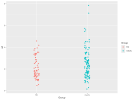
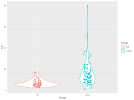
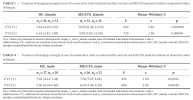
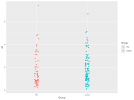
Second, CV calculated from rapid, repeated HGS trials is inherently confounded by fatigability. Even healthy individuals show measurable decline when repetitions are closely spaced, and ME/CFS patients exhibit a steeper decline correlated with disease severity [5]. Under these conditions, elevated CV is at least partly attributable to fatigability rather than altered motor control. Although the author excluded participants with pronounced fatigability, residual decline persists and could inflate CV (Figure 1). Also, the fatigability- based exclusion criterion removes subjects with the largest force decline, arguably representing more severe disease [5]. Such selective attrition distorts variance estimates and may obscure true group differences. Instead, more robust statistical modelling approaches would be preferable.
Third, the measurement protocol used differs substantially from those in which CV was originally proposed. Earlier studies conducted either few discrete trials with rest or analysed single- grip force–time curves – conditions unlikely to induce fatigability [2]. These findings cannot be directly transferred to a 10- repetition protocol, further limiting interpretability.
Finally, we were unable to reproduce the reported participant numbers using the publicly available dataset, despite applying the stated exclusion criteria.