“The findings remain relevant because they show there may be opportunities to use vaccines more efficiently without compromising immune responses” said MCRI’s Dr Nadia Mazarakis.
“Essentially it shows that public health officials can get ‘more bang for their buck’ with COVID vaccine boosters. If COVID cases were to ramp up again and there be strain on the vaccine supply, these findings could be key to expanding vaccination coverage quickly and preventing future infections and deaths. The findings could also prove helpful for future vaccines against other coronaviruses manufactured using similar technologies”, added Chaudhari.
Adult Immunizations as Part of Cardiovascular Care: 2026 ACC Concise Clinical Guidance, 2026, Heidenreich et al.
A Report of the American College of Cardiology Solution Set Oversight Committee
Neonatal antibody levels and treatment outcomes following maternal vaccination among NICU infants exposed to COVID-19 during pregnancy, 2026, Cao et al.
Abstract
The COVID-19 pandemic has profoundly affected maternal and child health worldwide, with pregnant women being particularly vulnerable to complications.
Vaccination during pregnancy has been shown to generate protective antibodies offering passive immunity to neonates, though concerns remain about potential risks.
This study aims to compare infants, specifically a high-risk NICU cohort, exposed and not exposed to COVID-19 vaccination in utero by evaluating their antibody levels, clinical and laboratory characteristics, and treatment outcomes.
A prospective study was conducted from January to December 2022 at the Neonatal Intensive Care Unit (NICU) of Vietnam National Children’s Hospital.
Neonates under 30 days old with respiratory distress born to mothers with COVID-19 were divided into vaccinated (n = 75) and unvaccinated groups (n = 46).
Data on maternal vaccination, clinical symptoms, laboratory findings, and treatment outcomes were collected and analyzed.
Neonates born to vaccinated mothers had significantly higher anti-spike (anti-S) antibody levels than those born to unvaccinated mothers (median [IQR]: 2929.00 [1063.00–7817.00] U/mL vs. 335.00 [153.65–3000.50] U/mL, p = 0.007).
This association remained significant after adjustment for gestational age and birth weight.
Clinical manifestations, most laboratory parameters, and neonatal outcomes, including mortality, duration of mechanical ventilation, and length of hospital stay, were comparable between the two groups.
Gestational age was lower in the vaccinated group (34.96 ± 4.03 weeks vs. 36.48 ± 3.77 weeks, p = 0.042).
This study suggests that maternal COVID-19 vaccination during pregnancy may enhance neonatal humoral immunity, as evidenced by significantly higher anti-S antibody levels in newborns.
This association remained significant after adjustment for gestational age and birth weight.
Maternal COVID-19 vaccination was not associated with adverse neonatal clinical or laboratory findings, nor with adverse neonatal outcomes.
The observed difference in gestational age raises questions that warrant further large-scale investigation.
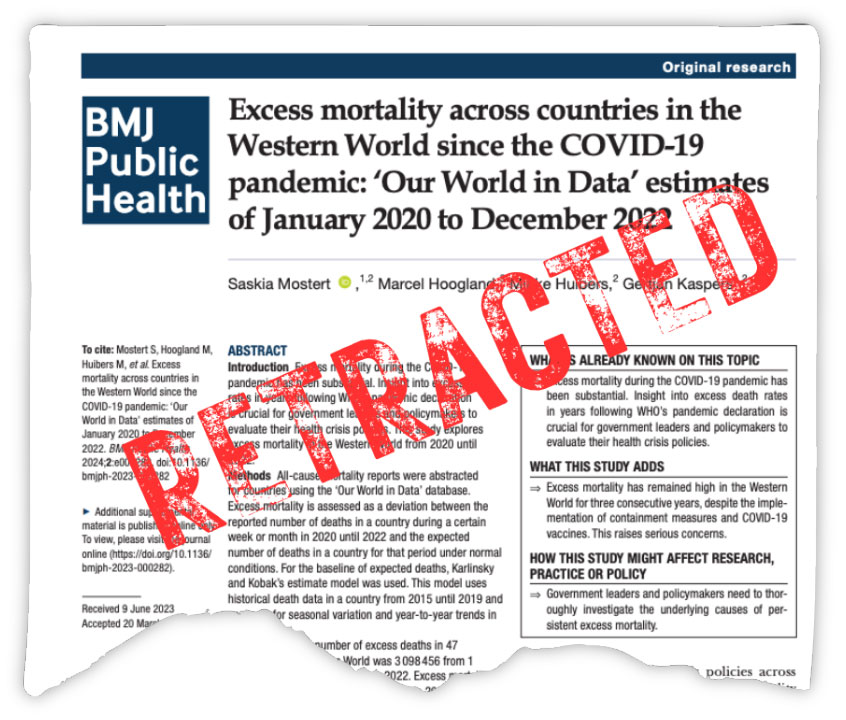
BMJ Public Health has retracted a paper some — including a witness at a recent U.S. Senate subcommittee hearing — have used to link COVID-19 vaccines to deaths. The action comes more than two years…
retractionwatch.com
BMJ Public Health has retracted a paper some — including a witness at a recent U.S. Senate subcommittee hearing — have used to link COVID-19 vaccines to deaths. The action comes more than two years after a researcher cited in the work flagged issues with the study.
Published May 6, 2024, the paper used the “Our World in Data” database and the World Mortality Dataset to look at COVID-19 related deaths during the height of the pandemic. News outlets covered it, from The Telegraph — “vaccines may have helped fuel rise in excess deaths” — to the New York Post, which quoted the paper’s statements about reported “serious injuries and deaths following vaccination,” a move it later corrected.
...
Critics of the paper said it contained misquotes and omissions on vaccines and was “full of inappropriate insinuation.” Ariel Karlinsky, an economist at Hebrew University in Jerusalem, Israel, and cocreator of the World Mortality Dataset, contacted the journal starting in June 2024, requesting a retraction multiple times. Karlinsky felt the analysis misused his data and “copied whole blocks of text and mathematical notation” from his article.
BREAKTHROUGH: World’s First Vaccine Targeting the Entire SARS Coronavirus Family Begins Human TestingGBP511, developed by UW Medicine and tested by SK Bioscience, aims to protect against COVID-19 and future coronaviruses before they spark the next pandemic.
Association between post-vaccination adverse events and subsequent COVID-19 booster uptake in the Netherlands, 2026, Huiberts et al.
Huiberts, Anne J.; Smits, Maud M.J.; Hoeve, Christina E.; de Melker, Hester E.; van den Hof, Susan; Knol, Mirjam J.
Abstract
Introduction
This study aimed to assess whether the occurrence, severity, and duration of AE following COVID-19 booster vaccination were associated with subsequent booster uptake during the 2022–2024 autumn booster campaigns in the Netherlands.
Methods
We included participants from the Vaccine Study COVID-19 (VASCO), an ongoing prospective cohort study, who were eligible for booster vaccination in 2022–2024. Participants completed a questionnaire on AE one month after booster vaccination. Logistic regression was performed to assess the association between the occurrence, severity, and duration of local and systemic AE, and revaccination during the subsequent year. We adjusted for demographics and prior SARS-CoV-2 infection.
Results
In 2022 and 2023, 11,010 and 14,824 participants were vaccinated and completed the AE questionnaire. Of these, 73.7% and 87.0% were revaccinated in subsequent years. The occurrence of systemic AE in 2022 was associated with a lower odds of revaccination in 2023 (OR: 0.84 [95%CI, 0.76–0.93]). The likelihood of revaccination declined with increasing severity– moderate (0.79 [0.66–0.94]) and severe AE (0.45 [0.34–0.60]) – and longer duration (>5 days: 0.72 [0.54–0.95]) of systemic AE. Also, severe local AE (0.38 [0.23–0.60]) and seeking medical care for AE (0.50 [0.34–0.73]) were associated with reduced vaccination uptake. Similar associations were observed for revaccination in 2024.
Conclusion
This study found a lower likelihood of subsequent COVID-19 booster uptake after experiencing systemic AE, particularly when severe or prolonged, or when experiencing a severe local AE. These findings underscore the need to address experienced AE in communication strategies, as this may influence the success of vaccination campaigns.
COVID-19 Vaccination and Risk of Post–COVID-19 Cardiovascular Disease: A Population-Based Cohort and Target Trial Emulation Study, 2026, Seboka et al.
Seboka, Binyam Tariku; Magliano, Dianna J; Marwick, Thomas H; Huynh, Quan
Abstract
Background
Whether COVID-19 vaccination is associated with lower long-term cardiovascular risk after SARS-CoV-2 infection and how much infection prevention mediates this association remain unclear.
Objective
To evaluate associations of vaccination, including its timing relative to SARS-CoV-2 infection, with post-COVID-19 cardiovascular disease (CVD), and quantify the contribution of infection prevention.
Methods
This statewide population-based cohort study used linked administrative health data for 2,391,456 adults in Victoria, Australia (2019–2025). Associations of pre- or post-infection vaccination with major adverse cardiovascular events (MACE; primary outcome), stroke, heart failure, acute myocardial infarction (AMI), acute coronary syndrome (ACS), atrial fibrillation (AF), and venous thromboembolism (VTE) were evaluated using time-varying Cox proportional hazards regression, causal mediation analysis, and target trial emulation.
Results
Vaccination was associated with lower hazards of MACE and all secondary outcomes. Estimated absolute risk reductions for MACE were 0.21% with pre-infection vaccination and 0.24% with post-infection vaccination. Three or more vaccine doses were associated with progressively lower hazards across cardiovascular outcomes. Mediation analysis suggested that approximately 68% of the estimated association between vaccination and lower post-COVID cardiovascular risk was not explained by prevention of SARS-CoV-2 infection.
Conclusion
Vaccination before or after SARS-CoV-2 infection was associated with lower hazards of post-COVID-19 cardiovascular outcomes, with stronger observed associations at higher dose numbers. Most of the estimated association was not explained by infection prevention alone. These findings support COVID-19 vaccination as an important component of strategies to reduce the burden of post-COVID-19 CVD while highlighting the need for further studies to clarify the mechanisms underlying these associations.
Web | DOI | PDF | European Heart Journal - Quality of Care and Clinical Outcomes | Open Access
Long-term adverse effects following COVID-19 vaccination, 2026, Aldali et al
Aldali, Jehad A.; Meo, Sultan Ayoub
Abstract
During the COVID-19 pandemic, vaccinations were highly beneficial to public health, preventing disease and reducing mortality. This study aimed to investigate long-term adverse clinical symptoms following COVID-19 vaccination with the Oxford AstraZeneca (ChAdOx1 nCoV-19, Oxford), Pfizer-BioNTech (BNT162b2), and Moderna (mRNA-1273) vaccines. In this cross-sectional study, the total number of participants was 429; among them, 243 (56.6%) were male, and 186 (43.4%) were female. An online Google Form was prepared in both Arabic and English and distributed to participants who received the Oxford AstraZeneca, Pfizer-BioNTech, and Moderna vaccines. The most common long-term adverse effects reported after COVID-19 vaccination were chronic fatigue, impaired cognitive function, and menstrual irregularity. The Moderna vaccine had a higher self-reported symptom rate among male participants (50–61.5%) than among female participants (33.3–28%). Chronic fatigue was more frequent among Oxford AstraZeneca recipients (34.7%) than among Moderna (22.2%) and Pfizer-BioNTech (27.7%) recipients. The second dose was associated with slightly higher rates of chronic fatigue among Oxford AstraZeneca recipients (38.9%) than among Moderna (25%) and Pfizer-BioNTech recipients (27.3%). For cognitive problems, the prevalence was similar across all brands (25%). Menstrual irregularity was slightly higher among females who received Pfizer-BioNTech (14.8%) than among Oxford AstraZeneca recipients (18.9%). The highest proportion of recipients who were infected after vaccination was among those who received the Oxford AstraZeneca vaccine (46.3%). In conclusion, the most commonly reported long-term adverse effects after COVID-19 vaccination were chronic fatigue, cognitive impairment, and menstrual irregularity. Further large-scale studies are required to provide more conclusive evidence.
Recommendations for COVID-19 Vaccines in Infants, Children, and Adolescents, 2026–2027: Technical Report
AUTHORS
Committee on Infectious Diseases
Abstract
This technical report accompanies the American Academy of Pediatrics policy statement recommendations for COVID-19 vaccination during the 2026–2027 respiratory virus season.
The rationale is presented for recommending vaccination in all infants and children 6 through 23 months of age, children 6 months through 18 years of age who are moderately or severely immunocompromised, and children 2 through 18 years of age in certain additional risk groups, including those at high risk of severe COVID-19, residents of long-term care facilities or other congregate settings, children who have never been vaccinated against COVID-19, and children whose household contacts are at high risk for severe COVID-19.
The report synthesizes currently available evidence on SARS-CoV-2 epidemiology, disease burden, COVID-19 vaccine effectiveness, vaccine safety, and vaccine cost-effectiveness in pediatric populations.
Additionally, the report provides an overview of available COVID-19 vaccine products, formulations, storage and handling considerations, and coadministration with other immunizations.
A combined vaccination is being trialled, and it's possible it's been licensed in places. But I guess even if it is licensed, it'll take a while to scale up production enough for the millions of people entitled to 'flu vaccinations?
I received a flu jab and the Moderna booster in the states about a month back when they first became available. I don't think it was a direct result of that, but I had my first substantial crash in a year or so two days afterward. I've never had an issue with a previous iteration beyond the using sore arm and feeling a little low for a day or two, and there were a number of complicating factors on the same day that I think more likely to have been the cause of the crash, but as I've heard a couple non-pwME (pw/oME?) say they took an extra few days to recover this year vs. previous years, I thought I'd put it out there, for whatever it's worth.
There's also a new mRNA flu vaccine from Moderna hitting the market - though I am not certain if that's the combined jab or just another individual option.
I've had six covid shots, and one kicked off 2+ months of PEM, and one a few weeks, and the rest nothing. Assuming, of course, that it was causally related...
Question Are congenital TORCH (toxoplasmosis, syphilis, rubella, cytomegalovirus, or herpes simplex) infections associated with neurodevelopmental and psychiatric outcomes?
Findings In this cohort study of 3 666 002 individuals born in Sweden, including 975 who were exposed, TORCH infections were associated with intellectual disability and autism in population analyses and sibling comparisons, with markedly higher risks for severe intellectual disability and autism with co-occurring intellectual disability.
Meaning This study found that congenital TORCH infections had associations with intellectual disability and autism, underscoring the importance of strengthening global vaccination programs and other preventive strategies.
Abstract
Importance Congenital TORCH (toxoplasmosis, syphilis, rubella, cytomegalovirus, or herpes simplex) infections are established causes of severe fetal injury, yet their population-level contribution to neurodevelopmental and psychiatric outcomes, independent of familial confounding, remains yet to be quantified.
Objective To investigate whether congenital TORCH infections are associated with neurodevelopmental and psychiatric outcomes, including autism and intellectual disability, as well as academic performance, using population-based and sibling-controlled analyses.
Design, Setting, and Participants This nationwide, population-based cohort study with sibling comparisons was conducted using linked data from Swedish national health, birth, insurance, education, and death registers. Individuals born in Sweden between 1987 and 2021, including individuals diagnosed with a congenital TORCH infection, were included. Full siblings were identified for within-family comparisons. Individuals were followed up from birth until death, emigration, or December 31, 2023. Data were analyzed from November 2025 to July 2026.
Exposure Clinically diagnosed congenital TORCH infections, identified from national registers, including cytomegalovirus, Toxoplasma gondii, rubella, and herpes simplex viruses.
Main Outcomes and Measures Autism (with and without co-occurring intellectual disability), intellectual disability (by severity), attention-deficit/hyperactivity disorder, obsessive-compulsive disorder, Tourette and chronic tic disorders, nonaffective psychosis, and standardized school grades at age 16 years were assessed. Associations were estimated with hazard ratios (HRs) using Cox regression and sibling-comparison models.
Results Among 3 666 002 individuals born in Sweden, including 3 665 027 individuals without TORCH infections (1 883 911 male [51.4%]; mean [SD] follow-up, 20.50 [11.15] years) and 975 individuals with TORCH infections (532 male [54.6%]; mean [SD] follow-up, 18.70 [10.39] years), congenital TORCH infections were associated with increased risks of intellectual disability (HR, 7.22; 95% CI, 6.14-8.49) and autism (HR, 3.10; 95% CI, 2.55-3.76), with similar or greater HRs in sibling comparisons (intellectual disability: HR, 11.28; 95% CI, 5.97-21.33; autism: HR, 3.19; 95% CI, 1.97-5.15). Risks increased with greater severity of intellectual disability, with HRs ranging from 3.01; 95% CI, 2.21-4.11 for mild to 23.51; 95% CI, 18.06-30.60 for severe to profound intellectual disability) and were greater for autism with (HR, 6.23; 95% CI, 4.69-8.28) vs without (HR, 1.97; 95% CI, 1.51-2.57) co-occurring intellectual disability. No consistent associations were observed for obsessive-compulsive disorder, and associations with attention-deficit/hyperactivity disorder attenuated in sibling analyses. Individuals who were exposed had lower school grades in adolescence (TORCH-associated decrease = −1.50 points; 95% CI, −2.60 to −0.40 points).
Conclusions and Relevance In this study, congenital TORCH infections were rare but associated with intellectual disability and autism, with evidence of broader associated cognitive outcomes extending beyond diagnosed conditions, underscoring the importance of preventing specific vertically transmitted infections.
Web | DOI | PMC | PDF | JAMA Pediatrics | Open Access
This site uses cookies to help personalise content, tailor your experience and to keep you logged in if you register.
By continuing to use this site, you are consenting to our use of cookies.