Genetics: Chromosome 15, CCPG1, UNC13C and more

ScoutB

Moderator
Staff member
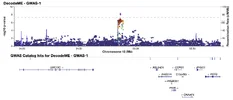
The lead variant at this locus is 15:54866724:A:G (rs7165327) with a p-value of 7.62E-09. DecodeME labelled CCPG1 as a Tier 2 gene. The nearest protein coding genes are UNC13C (at 234,980 bp), and then RSL24D1 (at 314,073 bp).

Though rs7165327 was a significant DecodeME hit, none of the nearest genes were identified as Tier 1 genes due to a lack of eQTL data. (See this post by ME/CFS Science Blog about why a lack of eQTL data may not be as much a point against a gene as initially thought.)
Screenshot 2026-09-04 at 4.27.38 PM.webp
(Source: LocusZoom)

[ To do: add gene card info and such ]
 
Made this thread partly just to note a minor connection:

Apparently CCPG1 UNC13C was associated in one GWAS with a higher level of a protein called protogenin in blood, and apparently protogenin is a member of the same family as DCC (Described here as "a subgroup of the immunoglobulin superfamily with roles in the migration and guidance of axon growth during development of the vertebrate nervous system") -- I gather it's structurally and mechanistically similar to DCC.

Quite a lot of jumps happening here, but a bit interesting we have signals pointing at the same DCC family of proteins coming from different chromosomes.
 
Last edited:
Had a closer look at this locus. The top SNP is a bit of an outlier ( lower p-value and imputation score than the SNPs it is in near perfect correlation with). So I think the signal is slightly below the significance threshold, but that doesn't matter much.

chromatin openess and histone marks
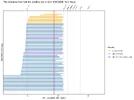
There are 152 SNPs in the credible set made by SUSIE. The ENCODE data, however, found only three regulatory elements that contained any of these SNPs. These were weak elements and didn't strongly point to any specific tissue although the one with most probability in it, ЕH38E3135114 tended to have higher z-values in the occipital lobe (and cerebellum). Below are the top five z-values for each of them.

1793732847963.webp

ЕH38E3135114 had the same position as chromatin openness peaks in the Li 2023 brain atlas, mostly in cortical neurons. It lies in the west of the credible set.

1793733019828.webp
 
3D contacts with Hi-C
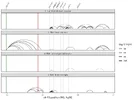
The domains that show how the region often folds and touches in 3D points also points to the western region where UNC13C lies, and none includes the genes to the east. More info and background about this analysis is given here.
1793733965328.webp
The link to UNC13C in the west is also seen in brain samples that show the loops where regions touch in 3D.


1793734131376.webp
1793734213393.webp


So despite being far away I think UNC13C might be the most likely candidate gene, for example in neuronal cells in the cortex.
 
eQTL
Looking at gene expression datasets, there wasn't really a result that matched the DecodeME signal well (all PP.H4 < 0.8).
1793734430962.webp
Phewas

Looking at genetic studies of other traits, gave almost no results - very different from other loci. Two reached a PP.H4 of 0.8 or higher, dementia in the FINGEN database and NET100 which I think is a functional MRI measure of connectivity.

1793734678739.webp
 
Haven't delved deep into what UNC13C does, it gene card says:
UNC13C encodes Unc-13 homolog C, a presynaptic regulator of synaptic vesicle priming and exocytosis. It is predicted to enable calmodulin binding and syntaxin-1 binding, placing it in the machinery that supports glutamatergic synaptic transmission and regulated release. The protein localizes to the presynaptic active zone, presynaptic membrane, membrane, and cytoplasm.

Mechanistically, UNC13C is associated with synaptic vesicle docking, synaptic vesicle priming, synaptic vesicle exocytosis, and dense core granule priming, linking ligand and calcium-sensitive binding activities to membrane fusion events. Its domain architecture includes a MUN domain, C1-like domain, and multiple C2 domains, and it is active in the axon terminus, parallel fiber to Purkinje cell synapse, and synaptic vesicle membrane. Expression measurements show RNA enrichment in brain and protein detection in the male reproductive system.

Pathogenic variants in UNC13C are reported in alacrima, achalasia, and impaired intellectual development syndrome. This links UNC13C to a neurodevelopmental and multisystem clinical phenotype characterized by the named disorder.
UNC13C Gene - GeneCards
 
Back
Top Bottom