Closed Mind Body Intervention for Long COVID-19 [Massachusetts, USA]

I think you're saying specifically the word "bothered" changes it from being about symptom levels, to about how symptoms are perceived, which is more susceptible to bias unrelated to improvement. And that it'd be better to choose a more direct scale that is more like "are the symptoms present >3 days a week".
I think it opens it up to misinterpreting improvement in distress as improvement in long covid.

Now, since Donnino thinks long covid is distress, he wouldn't see that as a problem.

But I do, because I found CBT good for coping, but it did nothing for my ME/CFS.

I was thinking you were moreso criticizing including the more severely affected in the trial, but I can see how this scale could be measuring something which can change even if symptoms don't change.
Oh no! Not at all.
 
From https://www.shapiroinstitute.org/faculty-staff/mike-donnino,-md

Professor in Emergency Medicine, not who you‘d expect to research mind-body approaches?
He's interested in it because of his personal experience with it. From the Wired article:
Michael Donnino, a professor of medicine at Harvard Medical School, also attributes his recovery to Sarno. Around a decade ago, he began suffering from horrific back pain. “I had stopped working in the hospital,” he told me. “I was on partial disability.” Round-the-clock Tylenol, ibuprofen, and gabapentin did nothing. Neither did steroid injections or oral steroids. His back specialist said he had piriformis syndrome, and scans showed a potential problem with his sciatic nerve.

But then Donnino saw accounts of miraculous Sarno book cures online. “I got two chapters into the book and I thought, this is a bunch of baloney,” he said. “This is ridiculous. It is nothing like what I learned in medical school.” After abandoning the book, something told him to give it one more chance. So he did. “Within 24 hours I was feeling tremendously better.” In less than a week he was back at work. In four months he was pain-free.

Donnino was inspired to design and run a pilot randomized controlled back pain trial that used Sarno’s approach (funded by the CEO of Quora, another Sarno convert). [...]
 
You have to hand it to them. They may not have resolved the issue of the uninterpretabability of unblinded trials which rely on subjective outcomes measures but they’ve found a way to introduce even more bias!

Now I’m wondering if the mysterious active comparator arm may be teaching the patients students to be more bothered about their symptoms.
 
From the Wired article (my bold):
But then Donnino saw accounts of miraculous Sarno book cures online. “I got two chapters into the book and I thought, this is a bunch of baloney,” he said. “This is ridiculous. It is nothing like what I learned in medical school.” After abandoning the book, something told him to give it one more chance. So he did. “Within 24 hours I was feeling tremendously better.” In less than a week he was back at work. In four months he was pain-free.

Donnino was inspired to design and run a pilot randomized controlled back pain trial that used Sarno’s approach
Funny that he chooses to mention that he was back at work in less than a week as evidence of the efficacy of the intervention, and yet he chose not to use returning to work as an outcome measure in his trial (or any other objective outcome measures). I don’t suppose he was taught to do that at medical school either – unless he was schooled in BPS methodology.
 
You have to hand it to them. They may not have resolved the issue of the uninterpretabability of unblinded trials which rely on subjective outcomes measures but they’ve found a way to introduce even more bias!

Now I’m wondering if the mysterious active comparator arm may be teaching the patients students to be more bothered about their symptoms.
This is pretty much it, isn't it? The discipline solved the bias problem by making bias a good thing, necessary even. So now they may still have a highly suspicious 90% or so success rate, which is obviously impossible, but by increasing the bias and setting the baseline as 90% success rate being the floor, mainly by defining success as whatever, then more bias means better so of course you want more bias. And they'll still claim equipoise because bias in favor of good outcomes is equipoise. If you aren't biased, you're doing it wrong,

What an incredibly odd thing. Truly one of the most bizarre eras in human history.
 
On the difference between mind-body brain retraining and CBT - I don't really think there is much difference. I suspect all of these sorts of courses are just a hodgepodge of various techniques aimed at telling the participants 'you are doing things all wrong, do what I say', along with a few relaxation techniques and a bit of psychotherapy, probably finding some trauma that has been repressed. So, sure, some nominal variation between individual offerings, but nothing particularly significant.

Possibly there used to be a distinction in that CBT is the offering from mainstream medicine and the brain retraining is offered by the private non-medically qualified charlatans who charge plenty. But, even that difference probably doesn't apply any more.

The trial website says recruiting, but the principal investigator posted on social media on June 5 that enrollment is closed, so I've edited the title.
I'm assuming that Alan Levinovitz has been told about the results from this participants who have finished the trial already. Presumably results are tracking along as expected, as otherwise AL would not be spruiking the trial. Even I am confident they will get a positive a result. If they don't, then they have really stuffed things up.


On the two mind-body treatment arms, I guess they can't be too clear which arm is the one that is supposed to work and which one is not in the online registry, as it would unblind the trial. It possibly creates some flexibility, as, if both of the treatment arms end up showing some benefits over the wait list control, they don't actually need to label one of them as a sham.
 
Add me to the list of those who does not see a particularly meaningful difference between mind-body brain retraining and CBT/GET approaches. They are both based on the notion of cognitive-perceptual reframing. The distinction is largely marketing in my view. They failed to sell it as CBT/GET and that brand has become toxic, so now they have re-branded it as brain retraining to keep the gravy train rolling.

Same basic approach, just with a different hat on.

A decade or two from now, when this latest brand has lost its mojo, they will invent another one.

I’m hopelessly biased about evidence.
My hopeless bias is methodology. The means by which evidence is collected and interpreted.

This is pretty much it, isn't it? The discipline solved the bias problem by making bias a good thing, necessary even.
That is exactly what they have done. Deliberately selected known biases and confounders in trial methodology for psycho-behavioural studies, emphasised and amplified them, and re-branded them as a therapeutic success.

Reality and patients' lives be damned.
 
This is the other thing isn’t it, designing a trial for a very specific thing completely misrepresenting it and saying it works for all things. I don’t doubt there are a group of people who can be helped by being ‘less bothered’ about things which cannot otherwise be changed (or some people do get spontaneously better or may be worsening a particular pain through tension or posture or whatever). I do doubt that you can cure all these physical problems by being less bothered about them. The former is acceptance, something many of us have had to do about our conditions and something which is important, the latter is denial, denial that these things are real and something which is hugely damaging.

Evangelists thinking they have found a magic cure after their own experience does tell us about people’s psychological makeup. But it’s not that there are loads of malingers or people who can overcome physical problems with mind over matter woo. It’s that some people have a very hard time accepting reality, their own fallibility and the capricious random nature of life, of accepting that they do not have control over their bodies and are not masters of all they survey and that sometimes things just happen randomly, for better or worse, no matter what they do. Massaging data and going through a twisted performative version of the scientific method to try to validate it is incredibly sad.
 
On the two mind-body treatment arms, I guess they can't be too clear which arm is the one that is supposed to work and which one is not in the online registry, as it would unblind the trial. It possibly creates some flexibility, as, if both of the treatment arms end up showing some benefits over the wait list control, they don't actually need to label one of them as a sham.

So this is a sham sham? It seems to be a sham but isn't? Since it is available online as a sham sham how can it even seem to be a sham? I am completely bemused. I cannot see how it can possibly be interpreted usefully.
 
designing a trial for a very specific thing completely misrepresenting it and saying it works for all things
This is really a spot-on description of what the pragmatic trial industry is doing. It's so appalling in itself that it's impossible to believe, thus shielding it from criticism. It's like being so constantly awful and corrupt that it isn't news anymore, allowing for more awfulness and corruption.
 
So this is a sham sham? It seems to be a sham but isn't? Since it is available online as a sham sham how can it even seem to be a sham? I am completely bemused. I cannot see how it can possibly be interpreted usefully.
I doubt they see it as a sham, hence the active control language. I'm sure they will be happy to report that they are both "effective", in that they have the same biases, which they can happily attribute to "placebo". This has become common practice, and it relies on math so that's how you know it's legit, because for sure 0=0.
 
From the preprint that @forestglip linked upthread

The goal of PSRT is to address underlying stressors and psychological contributors (such as underlying conflicts and aversive affective states) to nonspecific symptoms in order to mitigate conditioned symptom responses and fear-avoidant behaviors. Weeks zero through four of the course included group classes twice per week (90-120 minutes per class) and consisted of psychophysiologic education, desensitization (including visualization techniques), and emotional awareness exercises (such as expressive writing). Education focused on providing participants with information about the role of stress and psychological processes in precipitating and perpetuating physical symptoms. Using desensitization exercises, participants were encouraged to approach, rather than avoid, physical activities first through visualizing an action that typically induces symptoms and then through physical exposures of feared symptom-inducing activities.

The final 9 weeks of PSRT is the Mindfulness Based Stress Reduction (MBSR) protocol as outlined by the Center for Mindfulness at the University of Massachusetts (26). This portion consisted of classes once per week for a duration of 90 to 120 minutes and focused on providing participants with mindfulness skills such as practicing awareness of breath, body scan, and sitting meditation.

So, it seems likely that one arm will just be the Mindfulness Based Stress Reduction - i.e. mindfulness and meditation.

The other arm will probably be that plus instruction in 'psychophysiologic education, desensitisation (including visualisation techniques) and emotional awareness exercises (such as expressive writing)', with encouragement to approach rather than avoid physical activities.
 
Last edited:
From the preprint for the pilot that @forestglip linked upthread


So, it seems likely that one arm will just be the Mindfulness Based Stress Reduction - i.e. mindfulness and meditation.

The other arm will probably be that plus instruction in 'psychophysiologic education, desensitisation (including visualisation techniques) and emotional awareness exercises (such as expressive writing)', with encouragement to approach rather than than avoid physical activities.
Yes, I think the long COVID RCT will be more or less identical to this chronic pain RCT from the same author: https://s4me.info/threads/psychophy...ed-controlled-trial-2021-donnino-et-al.50684/
 
So, it seems likely that one arm will just be the Mindfulness Based Stress Reduction - i.e. mindfulness and meditation.

So there is a misprint in the protocol where it says 'Behavioral: Mind Body Intervention #1' twice. And the otherwise identical wording is an attempt to mask which is the 'test' treatment?
 
So there is a misprint in the protocol where it says 'Behavioral: Mind Body Intervention #1' twice. And the otherwise identical wording is an attempt to mask which is the 'test' treatment?
[Edit: I had misread Jonathan's comment so my first sentence is wrong: I don't think we can assume that. ] I think it's reasonable to try to blind participants as to whether they are in the experimental or comparator arm by not publicly describing which is which.

However, I can't imagine how you could create a true sham brain retraining that would both:
  • be as credible as sham acupuncture
  • not bias results on the SSS-8 by not encouraging patients to be less bothered by their symptoms, while the experimental arm does encourage that, and then asking patients how bothered they are by their symptoms

So I would guess this will be an active control, attention-matched, with shared components, but some differences that Donnino considers key ingredients of brain retraining. But let's see what #2 is when it's published.
 
Last edited:
I don't think we can assume that. I think it's reasonable to try to blind participants as to whether they are in the experimental or comparator arm by not publicly describing which is which.

I think it must be a misprint since in the first column the second group has a #2 marking. It just threw me suggesting that there were two groups with separate names but the same content.

I think there is an ethical issue if the investigators are actually trying to confuse patients about what they are going to receive.
So I would guess this will be an active control, attention-matched, with shared components, but some differences that Donnino considers key ingredients of brain retraining.

So then that would not be treatment #1 and it is either a misprint or an unethical misrepresentation.
 
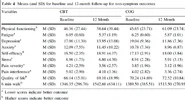
When multiple non-pharma treatments have gone head to head in ME/CFS, e.g. GET vs CBT or the various interventions in Jason et al. 2007, there's been little to separate them. In Jason et al. 2007, we actually get a face-off between PACE-style CBT that included activity increases (CBT) and a cognitive intervention focussed on coping that did not include activity increases (COG, and two other arms). While that coping intervention is different from Donnino's brain retraining in ways, it's similar in that it targets distress.

If we look at the findings, we can see that they're pretty similar in terms of their effect on physical functioning or fatigue, but if participants had filled out the SSS-8, might there have been a difference? I'm looking at the "Stress" and "Depression" rows in particular.

1781518351043.webp
 
Last edited:
Back
Top Bottom