Closed Mind Body Intervention for Long COVID-19 [Massachusetts, USA]

So there is a misprint in the protocol where it says 'Behavioral: Mind Body Intervention #1' twice. And the otherwise identical wording is an attempt to mask which is the 'test' treatment?

I think it must be a misprint since in the first column the second group has a #2 marking.
Sorry, yes, you are right, I had misread your initial comment as referring to column 1 rather than column 2!
 
If you download the supplemental data file of the pilot study here (the link is between the acknowledgements and the references), you get to see what the experimental treatment will probably be. Scroll down - the protocol starts after supplemental figure 2.

Psychophysiologic Symptom Relief Therapy (PSRT) Treatment Protocol

PSRT is based on the notion that nonspecific pain and idiopathic symptoms are a result of psychophysiological processes. The PSRT intervention consists of a single one-on-one session with an instructor, group educational and skills-training sessions, and a mindfulness-based stress reduction (MBSR) program which includes one full-day (approximately 6 hours) session/retreat. The group educational and skills training sessions are held twice per week for four weeks with each session lasting 1.5-2 hours. The MBSR program consists of one 1.5-2 hours class per week for eight weeks (in addition to the full-day MBSR retreat and an orientation class)…
That amount of contact would weed out the more severe who might have been captured by the SSS-8 in greater numbers, leaving those who scored higher on the SSS-8 due to higher distress overrepresented. (Relevant to our chat above, @forestglip!)

Note weeks 1-4 are components I-III. The last 9 weeks are mindfulness-based stress reduction:
Component I: Psychophysiologic Education

The goal of this component is to help participants recognize that their symptoms are part of a psychophysiologic process instead of arising solely from a physical etiology. Recognition of the psychophysiologic process is accomplished through education on the relationship between the mind and body, exploration of participants' pain and symptom history, and identifying “inconsistencies” in the experience of symptoms or pain (such as variation in symptom location or triggers). Understanding the relationship between psychological stressors and symptomatology is emphasized throughout the intervention. By identifying patterns of increased stress exacerbating symptoms, participants are able to appreciate the contribution of underlying stressors to their conditions. For example, one participant had pain when walking upstairs while at work but recognized (upon reflection during the course) that he did not have pain when walking up even more stairs when on a vacation…

Component II: Desensitization (including visualization) and returning to physical activity

Conditioned responses of pain and/or symptoms, perpetuated by psychological underpinnings, can arise after physical triggers and remain after the initial trigger subsides. Similar to the classical conditioning model, a neutral stimulus can become a symptom-inducing trigger when coupled with a pain/symptom-inducing stimulus...For example, muscle tension previously arising from pain may become associated with neutral stimuli like sitting or walking leading to fear, avoidance behavior, and restriction. As a result, a key portion of our intervention is “desensitization”; these techniques are aimed towards breaking the cycle of pain/symptoms and decoupling the fear of symptoms with the neutral stimuli.

Visual motor imagery (visualization of a symptom-inducing situation) is a desensitization technique where participants are asked to visualize a movement or action that typically induces symptoms. This visualization often brings on symptoms. When visualization induces symptoms, the notion that symptoms or pain are a result of a psychophysiologic process is reinforced. Participants are encouraged to repeatedly visualize movements or actions, without physically moving, while also engaging in self-soothing behavior like affirmational statements. This repetitive exposure to visualization-induced symptoms ultimately reduces symptoms until participants are no longer able to experience symptoms through visualization. At this point, when symptoms are no longer evoked from visualization, participants may begin to incorporate the movements or actions that they had visualized as inducing symptoms...

Another crucial component of desensitization is identifying the movements, actions or environments in a participant’s daily life that have been conditioned to induce symptoms or pain. For example, if sitting triggered symptoms, participants would sit and repeat the knowledge that their symptoms arising from sitting is conditioned instead of a response to a physical issue. With repeated exposure and practice, the neutral stimuli and pain/symptom response are decoupled or deconditioned and symptoms subside. Participants are then able to incorporate tasks and activities that they previously avoided. Through a successful return to daily life and activities, the “knowledge therapy” component of PSRT is reinforced as participants recognize that their symptoms do not arise from physical triggers but psychological ones. Participants can then safely return to activities under the supervision of a physician (example below)…

One participant was having pain in their hand and wrist while journaling about a stressful situation. The journal exercises were then intentionally changed to be about a joyful experience. Upon completing the exercise, the participant recognized that the pain did not come on while writing about a joyful experience…

Component III: Emotional expression - psychology of the syndrome

This emotional expression component of the treatment occurs in conjunction with the education and desensitization components. In 1959, the idea that chronic pain or chronic physical symptoms may be precipitated and perpetuated by avoided emotions and negative thought processes (e.g., anger that participants do not acknowledge or address) was described (4). Such ideas about emotions and physical symptoms have been supported by recent research (5–10). Treating a psychophysiologic disorder requires appreciation of factors that exacerbate chronic symptoms such as conflict and emotional avoidance, as well as incorporation of emotional expression strategies. Activities aimed at improving emotional expression, like writing exercises, journaling and self-reflection, give participants an opportunity to express avoided emotions which have previously exacerbated symptoms (11)…Journaling is performed both during the sessions and as a home practice and includes free writing, cluster writing, writing a compassionate letter to oneself, forgiveness of self or others, dialogues, or an unsent letter.16…Participants are also introduced to writing dialogues (writing as if they are two people interacting about a specific situation), and to writing an "unsent letter" where they write an expressive letter to a significant person (without actually sending the letter)…

Component IV: Stress reduction - Mindfulness Based Stress Reduction (MBSR)

The last nine weeks of the intervention are oriented towards developing techniques for stress reduction while continuing to practice what has been learned in the earlier weeks of the treatment. The knowledge gained in the earlier weeks along with the improvement of activities and symptoms allows for the optimal environment for this portion of the program...
 
Last edited:
All subjective self-report outcome measures.

Surprise! Or not.

They also describe the No Intervention: Usual Care arm as being a placebo, which is not legit, and the trial as controlled, which it is not because usual care does not control for therapeutic contact levels (i.e. the amount of time the patient spend with clinicians).

So, once again, all they have done is show they can induce modest modifications in some patients' questionnaire response behaviour, with no supporting objective evidence of that being of meaningful practical benefit. Just like the previous several thousand such methodologically inadequate trials.
 
Last edited:
As I expected, the active control was not sham brain training, it was mindfulness-based stress reduction. 9 of the 13-week brain training arm was also mindfulness-based stress reduction. Unclear if the MBSR group's MBSR was stretched so that they also received a 13-week intervention to match attention or not.

So the majority of the change in SSS-8 scores was due to MBSR, since the MBSR groups scores went from 20 to 12 while usual care group's scores went from 19 to 18.

The first half of the results lists median score changes which I put in a table:
1787915719523.webp

PSRT was different from MBSR and UC:
(p<0.001 for PSRT compared to both groups at all timepoints)
I presume they don't mean they were different at baseline, but at 4 weeks, 8 weeks and 13 weeks.

This is not surprising. The primary outcome, the SSS-8, measures how much people report being bothered by their symptoms (see post above), not whether they report having symptoms, and only the PSRT group were told not to be bothered by their symptoms.

The second half of the results resorts to describing within-group statistically significant changes in secondary outcomes compared to baseline. What matters is whether the PSRT group and the MBSR group differed.

But as always, it comes down to subjective outcome measures in an open-label trial. No info in the abstract on how participants were selected, but they were signing up for a trial of mind-body interventions, so there will be bias there unless they were consecutive referrals to a general LC clinic at a centre that isn't known for its mind-body bent. And see post #48 below about entry criteria.

The participants should be assessed again at 1 year and 2 years, to see whether group differences persist.
 
Last edited:
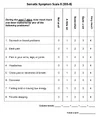
To recap the primary outcome measure, SSS-8:

1787916930854.webp
Full text article Gierk et al. 2014

The Somatic Symptom Scale-8 (SSS-8) is a brief, validated self-report instrument designed to assess the severity of somatic symptom burden. It serves as a short form of the Patient Health Questionnaire-15 (PHQ-15) and aligns with the diagnostic framework of Somatic Symptom Disorder (SSD) as defined by the DSM-5.

1787916897993.webp
 
And to recap why entry criteria could have caused a problem here:
People with more psychopathology will report being more bothered by symptoms that people with less psychopathology will find less bothersome. A bit like someone with depression describing an interaction at work as "horrific" whereas when they don't have depression, they might describe a similar interaction as "not ideal". So the average person with depression and long covid will score higher on this scale than the average person with long covid but not depression, and the person with depression will be more likely to make it into the trial because you had to score 10 or more. I don't think I would have scored more than 10 for the first few years.

Then the brain retraining/"psychophysiologic symptom relief therapy" explicitly instructs people to be less bothered by their symptoms.

So you can get a positive result by recruiting more people who are particularly distressed by their symptoms, teaching them that they don't need to be distressed by them, and then asking them again how bothered they are by their symptoms. They may be just as symptomatic, but report not being as bothered by those symptoms.

And when you try to roll the intervention out to the wider long covid population, you'll have fewer people who are pathologically distressed by their symptoms, and more people for whom the intervention does nothing.
 
I think that rightly qualifies as sham control. It's not as if it would have a different effect, it's not really possible to make a sham version of something that is already a sham.
Things can always get shammier. Sham homeopathy. But for it to be a sham control, participants would need to not be able to distinguish it from brain retraining, and I don't think that's the case here.
 
1000027605.webp1000027606.webp

He says quite funny things on X/Twitter when asked about why there were no objective outcomes or at least better questionnaires. Especially that he actually seems to believe that qualitative data like people calling his course "life-altering" right after they finished it really is a good counter-argument when being criticized for his subjective outcomes almost made me laugh. Also he likes to tag sketchy "recovery" accounts with his posts about the study.

If I recall correctly someone also asked about follow-up, like you see in his answer he indeed did a 6-months-follow-up, but only for the intervention group and not for the other 2.


Lastly let me add some further things I mostly learned from my psychology studies.

1. Every psychological intervention that involves therapy in any kind ideally needs a sham-treatment that involves the same amount of human contact. Because, as psychologists mostly learned from comparing different therapy 'schools' (CBT, psychoanalysis, systemic therapy etc...) for one illness, the most deciding aspect if people rate their therapy as a success isn't the style or method of therapy but actually the quality of the relationship between therapist and patient.

2. Many subjective outcomes is just asking people: "do you think you can do X" or very very rarely in the most optimistic case "can you do X", instead of simply asking "DID you do X in the last week/month/whatever?"

This gets problematic if you do it after a program where you tell them they MUST think they can.

For an example, that's like telling people with anxiety "you must believe you can do X despite your anxiety" again and again and then ask them "do you believe you can do X?".
People will answer yes no matter if they actually CAN and WILL do X after the intervention.

3. Don't underestimate the power of the willingness to please and of shame. People want to tell therapists/researchers they feel better, especially if there's a lot of human contact involved and they often feel reluctant to tell them if they aren't. This gets especially problematic when comparing usual care and intervention, because here you can't be blinded properly.

Of course shame and the willingness to please could possibly be even stronger if it comes together with point 2.
 
Back
Top Bottom