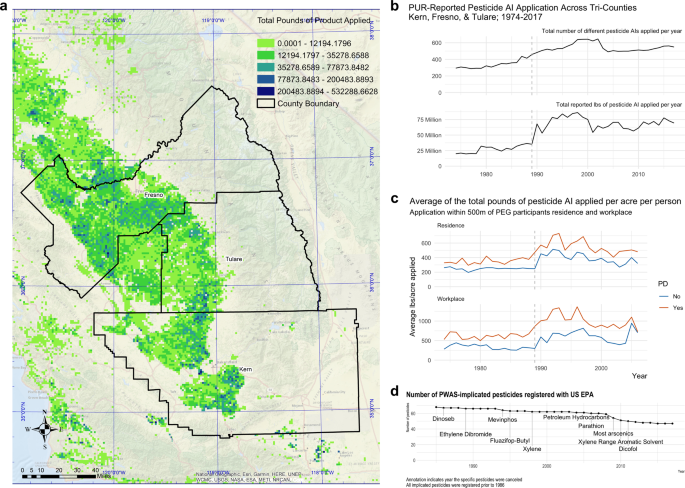
Yeah, if I ever have time/energy to look into this seriously, I'd want to know is if we can get a more solid idea of exposure. I have this memory that testing blood might tell you about someone's recent exposure level? So maybe there's a cross-sectional study out there with relevant info.
 
Or they breathe it, or the wind blows it onto their property while the neighboring farm is spraying, and it blows in their windows, or they get topical exposure from being outside. Ag chemical delivery is not precisely localized to the crops. Lots of ways to get dosed with pesticide that don't require working on a farm or drinking contaminated water.
 
And now found an old study that gave a negative result on the urban/rural difference, but it reports some very strange results overall so maybe something went a bit haywire here..

Prevalence of chronic fatigue syndrome in metropolitan, urban, and rural Georgia, 2007, Reeves
(The US state of Georgia). I don't think we have a thread on this yet. On top of a questionably high claimed CFS prevalence, they report the following bizarre F:M ratio situation:
We estimated that 2.54% of persons 18 to 59 years of age suffered from CFS. There were no significant differences in prevalence of CFS between metropolitan, urban or rural populations or between white and black residents of the three regions. However, there were significant differences in female-to-male ratios of prevalence across the strata (metropolitan female: male 11.2 : 1, urban 1.7 : 1, rural 0.8 : 1).

They acknowledge:
We estimated that 2.54% of the Georgia population suffers from CFS, which is 6- to 10-fold higher than previous population-based estimates in other geographic areas. These differences may reflect broader screening criteria and differences in the application of the case definition. However, we cannot exclude the possibility that CFS prevalence may be higher in Georgia than other areas where it has been measured.

Their methodology was complicated, trying to more carefully (in person) assess CFS status on a subset of their phone-screened sample and extrapolating from there. Would have to dig in to know if there's anything useful in this.
 
Nuclear, mining, fracking, drilling are all known to impact human and animal health.

If Native American communities were able to prove the US government contaminated their land and caused an increase of adverse health effects including cancer via uranium mining and radioactive contamination, to such an extent that the government compensated some of them--thus admitting nuclear storage and mining made these people sick and die--I don't see why the idea of environmental factors impacting pwME should be so far-fetched.
 
Last edited:
This survey found that people living in rural areas had twice the rate of ME/CFS as those in large cities
This could indicate several things. Exposure to agricultural chemicals. But it could also mean that people with ME/CFS are unable to live in large cities because of the cost of living and noise pollution. Some have simply had to move back to where they came from, I suppose.
 
I was not aware of this thread but I am happy to see that we are looking at environmental factors. I think one potential target here would be paraoxonase 1 and also the P450 system which was one of the first coming out to my analyses. If the detoxification system is compromised to an individual then even a normal exposure period could severely affect him
 
This is an interesting subject in a broader sense.

I remember years ago there was sentiment that humanity has never been healthier in history due to nutrition, medicine, and technology, but there remains relatively high rates of medically unexplained physical symptoms, so we must therefore adopt a biopychosocial or psychosomatic understanding, because, pressures of modern life, or whatever. Probably add in junk food and increased sedentary behaviours too.

But I frequently spotted science news articles about the effects of low dose toxins in the environment, the increased risk of various diseases, the effects on gut health and hormones, and how the wombs of pregnant women are 'awash' in a large number of chemicals which might be affecting embryonic development on some subtle level even if not causing birth defects.

The safety levels of some toxins have been revised down over time as scientists discovered that previous thresholds were too high. Surely the risk would reflect a dose-response relationship?

I think @forestglip provides a good analogy: The basement is flooded, but there has been more concern with finding a work around than looking in all places for the leak.

What made me revisit the issue recently was knowing someone with Parkinson's disease who lives very close to a golf course. For example:



Obviously it is premature for advocates to be promoting environmental toxins as a common etiological factor in ME/CFS but I would donate to large scale epidemiological research into this possibility.
 
Last edited:
Maybe. I don't know anything about water management. But surely someone's water in a big city is less likely to have certain pesticides than someone living in the middle of farm country.

I doubt it. Drinking water comes from reservoirs, which are mostly rural. People in rural areas do not drink from wells these days.

As far as I know the organophosphates blamed were used for animal delousing in dips? I am not sure if they are airbourne but again, urban air is much the same air as rural air half an hour or so earlier.
 
This may be a difference between UK/Europe and North America? I encounter well/ground water quite often here. From skimming, government sites seem to agree:
Environmental Protection Agency says:
Around 15 percent of the U.S. population (over 43 million) rely on private wells as their source of drinking water.

I've lived in cities that were on ground water as well. United States Geological Survey says:
Every day, millions of gallons of groundwater are pumped to supply drinking water for about 140 million people, almost one-half of the Nation’s population.

This made me look up if the UK is some utopia of soft water, but sadly it seems not:
Information from the Drinking Water Inspectorate shows that drinking water in England is generally considered to be 'very hard', with most areas of England [...] Water in London, for example, is mostly obtained from the River Thames and River Lea, both of which derive a significant proportion of their dry weather flow from springs in limestone and chalk aquifers.
 
But again that probably applies to both rural and urban houses?

Bore water is likely to be very well filtered. I am just sceptical that rural people are drinking poorly filtered run off water from fields covered in pesticide.
This might be a mute point but I grew up rural (on a farm) and we had rain water tanks ! (-meaning gathered off our roof/rooves into a tank and then pumped back into the house). A town supply wasnt available and the few natural springs on the farm were too meagre in summer to supply both us and our farm animals.
My parents had our water sent away for testing periodically and also the tank cleaned as necessary re sediment .
(Theres a minefield of possible contaminations. Council roadside spraying etc. Our water tested roughly once a year never showed issues).

Locally to where I live now some have rain water, others further afield still use old bore water systems.
 
Back
Top Bottom