United Kingdom News (including UK wide, England, NI and Wales - see separate thread for news from Scotland)

From AfME’s Facebook

We recently attended a Ministerial Meeting with Mabon ap Gwynfor MS, Cabinet Minister for Health and Care, alongside Welsh Association of ME and CFS Support, Severe ME Difrifol Cymru and Long Covid Support.

The meeting took place on Tuesday 28 July and focussed on discussing four key asks, which the Minister was very supportive of. The Minister confirmed that he will take away the key asks and keep the group informed. Read more about the meeting and key asks on our website

#MECFS #pwME #MyalgicE #MyalgicEncephalomyelitis
 

HPV home-testing kits available for women in England who have missed cervical screening​


Women who have missed a cervical screening appointment in England are to be offered HPV self-testing kits by the NHS.​
Over the next year, nearly four million will receive invites on the NHS App or via text message, email or letter to order a free kit to use at home.​
Figures show around a third of women who are eligible cervical cancer screening have not taken up the offer recently.​

…​

Cervical cancer often doesn't cause any symptoms until the disease is more advanced and harder to treat.​
"If you receive an invite to cervical screening, or an offer of a self-testing kit, please don't ignore it - it could save your life."​

 
Tern on Twitter:

Just the sickness absence rate of the biggest employer in Europe.

View attachment 33541
A German institute registered a doubling of the cost of sickness absences for Germany within the last 15 years.
Higher wages, rising employment,
and the level of sickness absence are mentioned as reasons.
Moreover, they consider this to be a significant factor for Germany:
Since the introduction of electronic recording of certificates of incapacity for work in 2022, the sickness absence rate has risen significantly in statistical terms.
I would find it interesting to learn whether there have been similar digitalization efforts in England.

The Twitter accounts I have followed were very Covid focused.
However, are there other factors than Covid that can better explain these changes in England since the start of the pandemic?
 
A German institute registered a doubling of the cost of sickness absences for Germany within the last 15 years.
Higher wages, rising employment,
and the level of sickness absence are mentioned as reasons.
Moreover, they consider this to be a significant factor for Germany:

I would find it interesting to learn whether there have been similar digitalization efforts in England.

The Twitter accounts I have followed were very Covid focused.
However, are there other factors than Covid that can better explain these changes in England since the start of the pandemic?

'The rise in incapacity benefits 2013-2024 coincided with a rise in the state pension age'

The Office for Budget Responsibility Welfare Trends Report, October 2024
https://obr.uk/box/the-effects-of-a...pension-age-on-incapacity-benefits-caseloads/


'Updated statistics from the Office for Budget Responsibility (OBR) show that, rather than “spiraling out of control”, social security spending is predicted to be lower in 2029-30 than it is this year"

 
Source: The Sussex Argus
Date: August 31, 2026
Author: Samanta Gladkauskaite
URL:
https://www.theargus.co.uk/news/26502429.sussex-patients-severe-neglected-amid-nhs-care-gap/


Sussex patients with severe ME 'neglected' amid NHS care gap
------------------------------------------------------------
Patients with severe forms of ME are being 'neglected' due to gaps in NHS care, the ME Society has warned.

The ME Society says the NHS Sussex-wide ME/CFS service, which is only contracted to see patients with mild and moderate Myalgic
Encephalomyelitis (ME) or Chronic Fatigue Syndrome (CFS).

Colin Barton of the ME Society said: 'The NHS Sussex-wide ME/CFS service
that does outstanding work is only contracted to take referrals for mild and moderately affected patients, leaving the most in need the most neglected.'

The issue was raised by Sussex MPs Alison Bennett and Chris Ward, who
have written to the regional Integrated Care Board (ICB) asking what
plans are in place to make sure that better provision is provided for
those severely affected by Myalgic encephalomyelitis (ME) or Chronic
fatigue syndrome (CFS).

Around 15 per cent of the nearly 4,000 ME/CFS patients in the county are
affected severely or very severely.

National Institute for Health and Care Excellence (NICE) guidelines
describe people with severe ME/CFS as often unable to leave the house,
often extremely sensitive to light and sound and sometimes spending most
of their time in bed.

Those with very severe ME/CFS may be unable to swallow, require tube
feeding and are in bed all day and dependent on care.
 

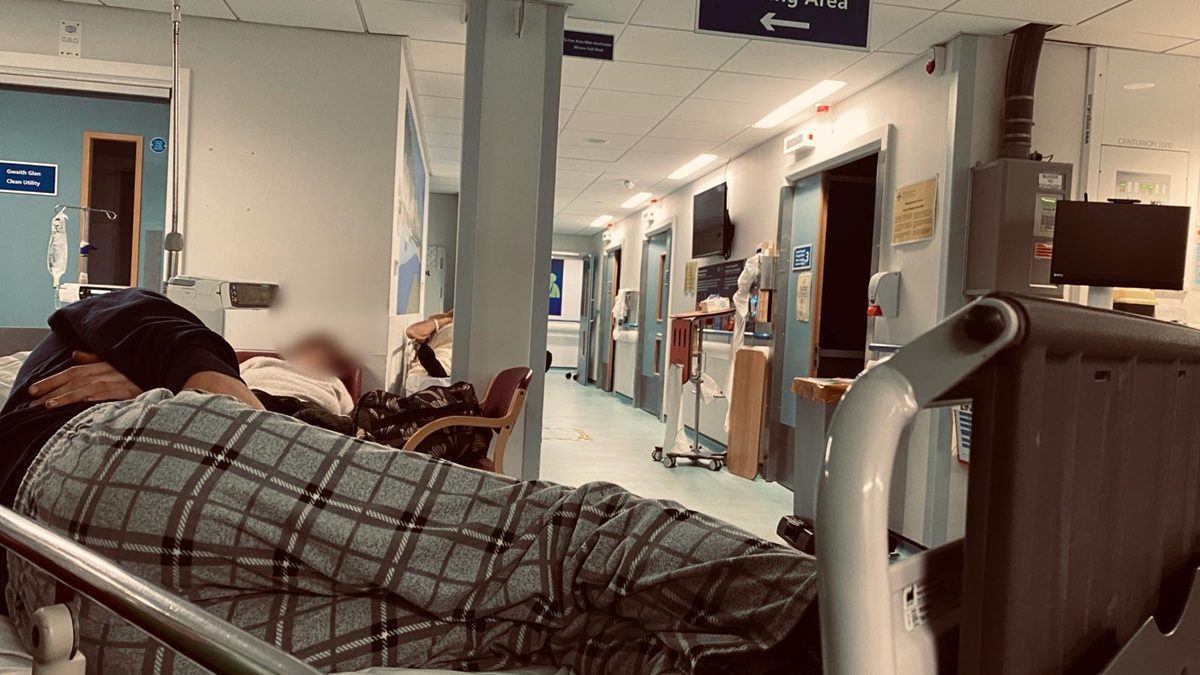
Why are patients being treated in hospital corridors in Wales – and can it be stopped?​

01 Sep 2026


How widespread is it in Wales?
One of the central findings highlighted by Senedd Research is that nobody knows precisely.​
Unlike in England, national statistics on the incidence of corridor care are not routinely published in Wales.​
A snapshot survey by the Royal College of Emergency Medicine (RCEM), carried out over three days in January and February 2025, found all 12 major emergency departments in Wales were treating patients in corridors.​
On average, 13.5% of patients in those departments were being treated on trolleys in corridors or other inappropriate spaces when the survey was carried out.​
But because it covered only three days, the figures cannot show how frequently corridor care occurs throughout the year.​


Why can’t hospitals simply find more beds?
Because, as the Senedd Research analysis makes clear, the causes of overcrowding stretch far beyond emergency departments themselves.​
One of the biggest problems is the movement of patients through hospitals.​
If somebody who is medically fit to leave hospital cannot be discharged because appropriate social or community care isn’t available, their bed remains occupied.​
That means another patient cannot be moved out of the emergency department into the hospital, which in turn leaves less capacity for newly arriving patients.​
Senedd committees examining patient flow during the previous parliamentary term identified shortages in social care capacity and problems with cooperation between health and social care services as contributors to delayed discharges.​
There is also the physical condition and capacity of hospitals themselves.​
The Welsh NHS Confederation has argued that maintaining, modernising and expanding the NHS estate is crucial to improving patient flow. The maintenance backlog across the Welsh NHS stands at £1.4bn.​


2nd September 2026

THE MIRRORBOX: ROYAL OPERA HOUSE INSTALLATION GIVES A VOICE TO PEOPLE LIVING WITH ME AND LONG COVID​


What is The Mirrorbox?

The Mirrorbox is a touring interactive sculpture created as part of I Would Be Here If I Could, a collaborative social art project co-created with people living with ME and Long Covid.

The installation travels to locations across the UK that hold special meaning for people who can no longer physically reach them.

At each stop, visitors can step inside the mirrored structure and hear a message from someone who has chosen that particular location as a place they love.

At the Royal Opera House, visitors will hear a message from Charlotte W, who has selected the theatre as somewhere special to her but is no longer able to visit because of illness.

After listening to Charlotte’s message, visitors will be invited to write her a postcard in response. The project team will then share the postcards with her, creating a unique exchange between someone who cannot be physically present and those who can.

When is The Mirrorbox at the Royal Opera House?

The Mirrorbox will be open to the public:

Saturday 12 September 2026
12pm–6pm


Sunday 13 September 2026
12pm–6pm

There will also be an early opening from 11am to 12pm on Sunday 13 September specifically for visitors with access needs.

The installation is located in the Paul Hamlyn Hall at the Royal Opera House and is free to attend.

Can’t Make It to London? You Can Take Part Online

One of the most important elements of The Mirrorbox is that people don’t have to physically visit the installation to participate.

Through the project’s online message map, visitors can listen to messages from people living with ME and Long Covid and send digital postcards in response.

Explore The Mirrorbox Online Message Map

This remote element reflects the project’s central message: participation in culture and public life shouldn’t depend on someone’s ability to physically be present.


Wiltshire's Long Covid service to continue until April​

A "lifeline" service for long Covid patients is proposed to continue for the rest of the financial year, following user demand.
In March, health chiefs said the Bath and North East Somerset, Swindon, and Wiltshire Long Covid service could be wound down as the number of patients declined.​
But following a review, the service will continue to operate until at least April 2027, Wiltshire Council's Health Select Committee will be told next week.​
…​
The proposal to continue the service was made after an engagement exercise with patients, carers, clinicians, and stakeholders revealed that the service is "highly valued" by those who use it - despite the number of referrals falling from nearly 80 a month during the early stages of the service to approximately 11 referrals per month in 2026.​


“Assisted dying” and the psychiatric reality of death​

Posted on August 17, 2026

Author: Prof. Charlotte Wilson Jones, Professor of Psychiatry Education & Innovation; Director of Mental Health Education at Kings College London.

Prof. Wilson Jones works as an end-of-life care psychiatrist, psycho-oncologist and has over 3 decades of experience in the field. Here, she explores how proposed assisted dying legislation for England and Wales may impact on practice

Last paragraph:

The outcome of getting the assessment wrong is fatal.​
Before Parliament changes the law, then, it should ask a basic clinical question, are we sufficiently equipped to distinguish an enduring, autonomous wish to die from one shaped by depression, hopelessness, coercion, fear, dependency, inadequate care or the belief that a person’s life has become a burden?​
After decades of caring for people at the end of life, I am convinced we are not there yet.​


Back
Top Bottom