Genetics: Chromosome 1 RABGAP1L, GPR52, SERPINC1, ZBTB37

I get the impression that GPR52 might be the relay receiving "erroneous" signals from another part of the brain.

The benefit for schizophrenia seems to lie in the possibility of avoiding hyperprolactinaemia whilst achieving the same effect as traditional antipsychotics. Among other things, cognitive improvements.

I think it could be interesting to take part in exploratory research (since this still seems to be the only stage at present) into GPR52 agonists and antagonists.
 
Haven't been able to keep up with all of these threads but just to note that there are a few entries in DGIdb, the drug-gene interaction database, for GPR52:

drug type direction conceptId COMP-43 inhibitor INHIBITORY iuphar.ligand:13995 COMPOUND 7A [PMID: 24884590] agonist ACTIVATING iuphar.ligand:8840 DERIVATIVE 17 [NAKAHATA ET AL., 2018] agonist ACTIVATING iuphar.ligand:9804 NXE0041178 agonist ACTIVATING iuphar.ligand:13909

Notably, PubMed ID 24884590 is this 2014 paper which explored the development of GPR52 agonists as a potentially new class of antipsychotics:
GPR52 inhibits dopamine D2 receptor signaling and activates dopamine D1/N-methyl-d-aspartate receptors via intracellular cAMP accumulation, and therefore, GPR52 agonists may have potential as a novel class of antipsychotics. A series of GPR52 agonists with a bicyclic core was designed to fix the conformation of the phenethyl ether moiety of compounds 2a and 2b.
 
Sorry was just reviewing this, and maybe we have exhausted all options. Is there any methods left to try to get a more accurate pin on which gene this region is pointing too? I think this just came up as significant in the larger GWAS:

 
This paper was interesting, "Gpr52 is located within an intron of Rabgap1".

A striatal-enriched intronic GPCR modulates huntingtin levels and toxicity

Yao, Yuwei; Cui, Xiaotian; Al-Ramahi, Ismael; Sun, Xiaoli; Li, Bo; Hou, Jiapeng; Difiglia, Marian; Palacino, James; Wu, Zhi-Ying; Ma, Lixiang; Botas, Juan; Lu, Boxun

Abstract
Huntington's disease (HD) represents an important model for neurodegenerative disorders and proteinopathies. It is mainly caused by cytotoxicity of the mutant huntingtin protein (Htt) with an expanded polyQ stretch. While Htt is ubiquitously expressed, HD is characterized by selective neurodegeneration of the striatum. Here we report a striatal-enriched orphan G protein-coupled receptor(GPCR) Gpr52 as a stabilizer of Htt in vitro and in vivo. Gpr52 modulates Htt via cAMP-dependent but PKA independent mechanisms. Gpr52 is located within an intron of Rabgap1l , which exhibits epistatic effects on Gpr52-mediated modulation of Htt levels by inhibiting its substrate Rab39B , which co-localizes with Htt and translocates Htt to the endoplasmic reticulum. Finally, reducing Gpr52 suppresses HD phenotypes in both patient iPS-derived neurons and in vivo Drosophila HD models. Thus, our discovery reveals modulation of Htt levels by a striatal-enriched GPCR via its GPCR function, providing insights into the selective neurodegeneration and potential treatment strategies.

Web | DOI | PMC | PDF | eLife
 
I had a closer look at this locus using the methods I previously applied to chr20 and other loci. No breakthrough unfortunately, but I’m sharing my results in case they are useful to others.

Finemapping
Finemapping the locus with SUSIE gave one credible set with 92 SNPs. But ca. 80% of the probability lies in the 30 SNPs that span a region that includes genes DARS2, ZBTB37 and SERPINC1. I'm calling this the 'core'.
1792953894589.webp

Chromatin openness
Using the SCREEN registry I found five regulatory elements inside the core. The DNAse result for chromatin openness mostly points to (activated) T-cells, especially for EH38E1398570, but for most of the others as well. The screenshot below shows the top 3 samples (highest z-values) for each of the 5 regulatory elements.

1792953910813.webp

AlphaGenome hinted at the largest and most consistent effect for rs7349095 (which lies in EH38E2848711), also in T-cells. It makes the chromatin more open in T-cells.

eQTL
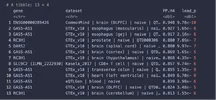
The eQTL data, however, did not clearly point in the immune direction or T-cells. Below are some databases on gene expression that have a similar signal with DecodeME in this region (coloc PP.H4 > 0.8). GAS5-AS1 comes up in multiple tissue. It’s an antisense to GAS5. GAS5 itself isn’t a protein-coding gene but a non-coding RNA that acts as a glucocorticoid receptor decoy.
1792953932341.webp

Phewas
When looking for other GWAS with similar signals in this region, I found the following. Things related to beer consumption come up, as does tiredness in the past 2 weeks.
1792953955415.webp
 
Last edited:
Those PHEWAS (studies checking genetic variants against phenotypes) results look intriguing - also headache, frailty, psychoactive drinks consumption (energy drinks, coffee?).

Genecards entry for ZBTB37
ZBTB37 encodes a BTB-domain zinc finger transcription factor that binds double-stranded DNA and regulates transcription. It is placed in the nucleus and nucleoplasm, with additional localization reported in the cytosol and fibrillar center. Expression is noted in brain, endocrine system, and proximal digestive tract, and RNA expression is detectable in the peripheral nervous system, hematopoietic system, and female reproductive system.

Through its sequence-specific DNA-binding activity, ZBTB37 is linked to negative regulation of transcription by RNA polymerase II and to regulation of cytokine production and immune system processes. Its BTB/POZ and C2H2 zinc finger domains support transcription regulator activity, consistent with a role in chromatin-associated control of gene expression. The protein carries phosphorylation and glycosylation sites, features that fit a regulated nuclear factor engaged in transcriptional control.
I'm not sure if we have had a good discussion about it yet? I've added it to the thread title.
"role in chromatin-associated control of gene expression"
"linked to... regulation of cytokine production and immune system processes"
 
I had a closer look at this locus using the methods I previously applied to chr20 and other loci. No breakthrough unfortunately, but I’m sharing my results in case they are useful to others.

Finemapping
Finemapping the locus with SUSIE gave one credible set with 92 SNPs. But ca. 80% of the probability lies in the 30 SNPs that span a region that includes genes DARS2, ZBTB37 and SERPINC1. I'm calling this the 'core'.
View attachment 34852

Chromatin openness
Using the SCREEN registry I found five regulatory elements inside the core. The DNAse result for chromatin openness mostly points to (activated) T-cells, especially for EH38E1398570, but for most of the others as well. The screenshot below shows the top 3 samples (highest z-values) for each of the 5 regulatory elements.

View attachment 34853

AlphaGenome hinted at the largest and most consistent effect for rs7349095 (which lies in EH38E2848711), also in T-cells. It makes the chromatin more open in T-cells.

eQTL
The eQTL data, however, did not clearly point in the immune direction or T-cells. Below are some databases on gene expression that have a similar signal with DecodeME in this region (coloc PP.H4 > 0.8). GAS5-AS1 comes up in multiple tissue. It’s an antisense to GAS5. GAS5 itself isn’t a protein-coding gene but a non-coding RNA that acts as a glucocorticoid receptor decoy.
View attachment 34854

Phewas
When looking for other GWAS with similar signals in this region, I found the following. Things related to beer consumption come up, was does tiredness in the past 2 weeks.
View attachment 34855
Thanks, that’s interesting.

I think the GAS5 antisense gene hits are just more support that these variants primarily change things by keeping that dense regulatory region between GAS5 and ZBTB37 open.

From a quick google it looks like several other TFs in the ZBTB family are active in various T cell responses. I'm guessing that the gene originates from some transposon element or something like that, so it's originally a copy of another similar region in the genome (complete with the T cell-specific regulatory motifs). That would explain the chromatin changes primarily pointing towards T cells, though the regulatory region seems to be accessible in a bunch of other cell types as well.

This is probably one of those particularly context-specific loci.
 
Back
Top Bottom