Genetics: Chromosome 17 CA10

For me, the touch hypersensitivity (allodynia) plays a dance with myofacial pain and is greatly increased by over exertion and then it is definitely extremely painful to the extent it is torturous and follows the PEM pattern.

I have always been struck when reading people's descriptions on this forum at the diverse hypersensitivities that are expressed by members.
 
I previously did that colocalization testing using the tool on Open GWAS, and it showed that the ME/CFS CA10 locus colocalizes with a few methQTLs (variants which cause differential methylation at a particular place on the genome):
TraitData typeGeneTissueCis/TransP-value
ME/CFS2.11e-9
CA10 Whole blood cg04881814 methQTLMethylationCA10Whole bloodcis0.00e+0
CA10 Whole blood cg07398767 methQTLMethylationCA10Whole bloodcis4.19e-14
CA10 Whole blood cg08605326 methQTLMethylationCA10Whole bloodcis4.10e-19
CA10 Whole blood cg20552747 methQTLMethylationCA10Whole bloodcis1.87e-15

I think the methQTL data is from the GoDMC project. I searched for the lead ME/CFS CA10 SNP on there, and it showed that it is associated with three of the four methylation sites above: https://mqtldb.godmc.org.uk/search?query=rs34626694

Here's the data from that search:
rsida1a2namecpgbeta_a1sesamplesizepvalcistransclumpedhetisqdirection
rs34626694TCchr17:50260366:SNPcg04881814-0.29668060.0089328272227.10E-2421090.5------+----+------------?--------++-
rs34626694TCchr17:50260366:SNPcg086053260.07158970.0092083268787.58E-151030.7++++++-++++++++++++++?+-?-+++++-++++
rs34626694TCchr17:50260366:SNPcg073987670.04967530.0091582272225.82E-081015.2-+++-+++-++++-++--++++++?--+++++++--

So the first of these, cg04881814, is extremely significant compared to the others, with p=7.1e-242. The beta is negative for the T allele (the ME/CFS risk allele). The direction column shows the direction of methylation for each of the cohorts that were tested in this database, and it shows negative for almost all of them. I think this means there is a strong association between the T allele and demethylation at this site.

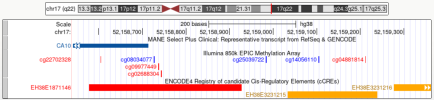
Here is that methylation site, cg04881814, on UCSC Genome Browser. It's the one furthest to the right, and it overlaps the enhancer EH38E3231215 near the start of CA10.

1778810128991.png

The genome browser links to this website for that enhancer: https://screen.wenglab.org/GRCh38/ccre/EH38E3231215

I don't know what else to do with this information, or how to interpret what's on that enhancer page.
 
The screening questionnaire asked

"In the last 6 months, have you been over-sensitive or intolerant to any of the following things often, repeatedly, or constantly? Please mark any that apply. If none apply, leave all the boxes blank.
Alcohol
Chemicals
Food
Light
Medicine
Noise
Smells
Touch
Other things"

and the secondary questionnaire, which only a sub-set of participants completed, asked if "Sensitivities/intolerances" would "get worse or develop" when experiencing PEM.
Also to add that both questionnaires asked about pain in a number of ways.
 
I miss there heat intolerance, or was it in the cathegory "other things"?
Heat and/or cold intolerance could be indicated under the broad 'other things'. The screening questionnaire also had a question that, in part, asked

In the last 6 months, have you had any of the symptoms below often, repeatedly, or constantly? Please mark any that apply. If none apply, leave all the boxes blank.

Finding it hard to cope with being in very hot or cold places
 
It seems that we may have missed a trick by ignoring the buspirone challenge test (there is an old thread on it) which might provide further evidence for disturbance of sensory pathways impacting on hypothalamus.
Thread here:
 
I previously did that colocalization testing using the tool on Open GWAS, and it showed that the ME/CFS CA10 locus colocalizes with a few methQTLs (variants which cause differential methylation at a particular place on the genome):


I think the methQTL data is from the GoDMC project. I searched for the lead ME/CFS CA10 SNP on there, and it showed that it is associated with three of the four methylation sites above: https://mqtldb.godmc.org.uk/search?query=rs34626694

Here's the data from that search:


So the first of these, cg04881814, is extremely significant compared to the others, with p=7.1e-242. The beta is negative for the T allele (the ME/CFS risk allele). The direction column shows the direction of methylation for each of the cohorts that were tested in this database, and it shows negative for almost all of them. I think this means there is a strong association between the T allele and demethylation at this site.

Here is that methylation site, cg04881814, on UCSC Genome Browser. It's the one furthest to the right, and it overlaps the enhancer EH38E3231215 near the start of CA10.

View attachment 32335

The genome browser links to this website for that enhancer: https://screen.wenglab.org/GRCh38/ccre/EH38E3231215

I don't know what else to do with this information, or how to interpret what's on that enhancer page.
Nice work again!!!
 
Back
Top Bottom