
You are using an out of date browser. It may not display this or other websites correctly.
You should upgrade or use an alternative browser.
You should upgrade or use an alternative browser.
USA: News from Solve ME
- Thread starter Andy
- Start date


ahimsa
Senior Member (Voting Rights)
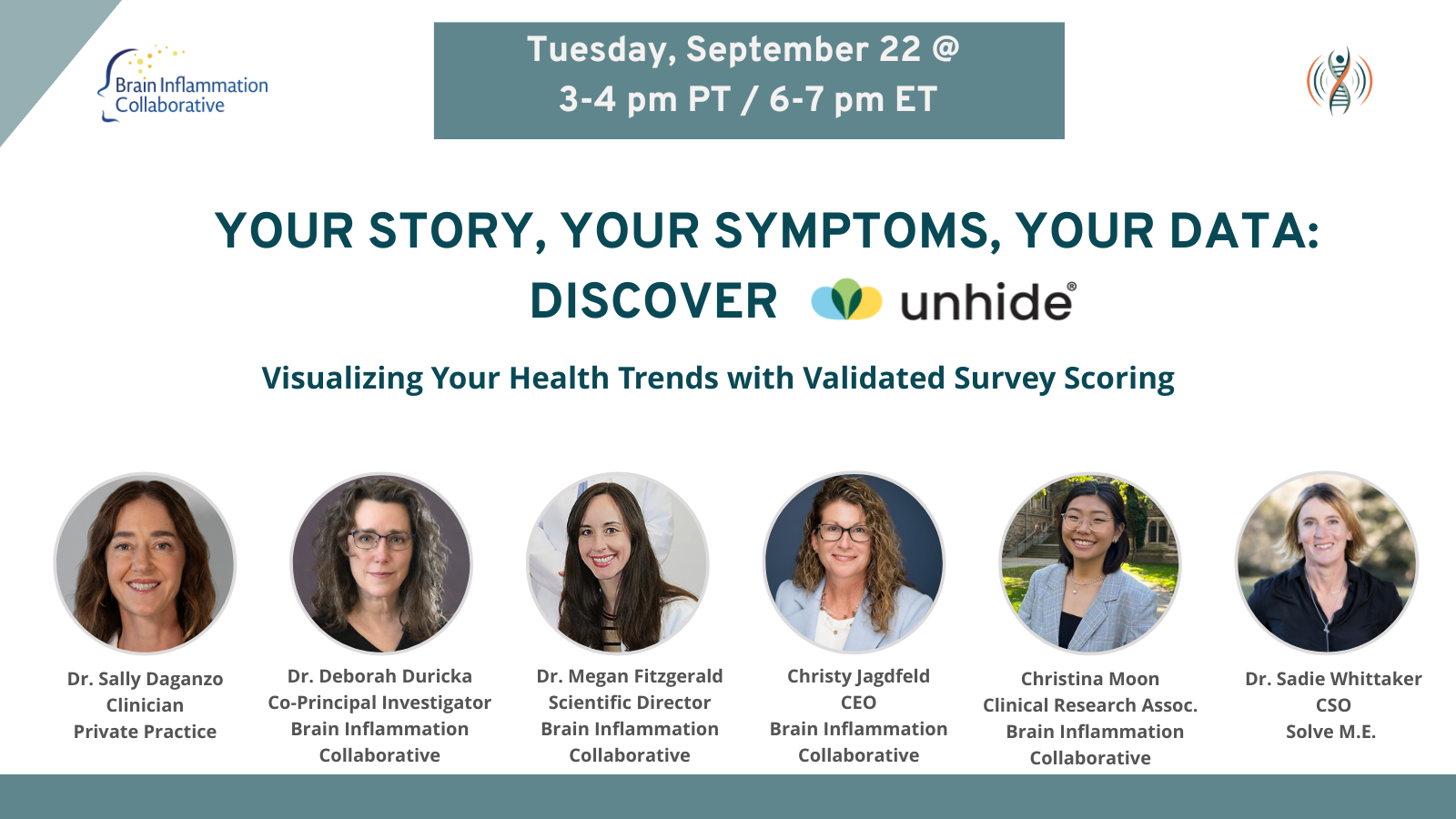
Solve ME Webinar:
"Your Story, Your Symptoms, Your Data: Discover unhide ®"
Tuesday, September 22
3:00 pm - 4:00 pm PDT
 solvecfs.org
Registration Link
"Your Story, Your Symptoms, Your Data: Discover unhide ®"
Tuesday, September 22
3:00 pm - 4:00 pm PDT
Your Story, Your Symptoms, Your Data: Discover unhide® - Solve ME/CFS Initiative
Join Solve CSO Dr. Sadie Whittaker and panelists from the Brain Inflammation Collaborative (BIC) for a free webinar on the unhide® real-world data platform.
solvecfs.org
Solve ME said:Living with ME/CFS, Long Covid, and related complex chronic conditions can make it difficult to explain how you’re feeling or to know whether a treatment is truly helping. Symptoms like pain, fatigue, brain fog, behavior changes, and post-exertional malaise (PEM) can fluctuate, making it especially challenging to remember and communicate what has changed between medical visits.
That’s where tracking your health over time can help.
The unhide® real-world data platform uses validated health surveys to collect detailed information about your health over time, and makes it easy to visualize a large amount of information at a glance. Using the data from unhide®, patients can better recognize patterns and trends to support conversations with healthcare providers.
In this webinar, the unhide® team will demonstrate how patients and caregivers can use this resource and its research-validated tools to track symptoms, better understand changes in symptoms and daily functioning, prepare for medical visits, and contribute valuable data that researchers can use to improve understanding and treatment. They’ll also explain what these scores can, and can’t, tell you, and how participating in unhide® can help researchers better understand complex chronic conditions.
Registration Link

ChronicallyOverIt
Senior Member (Voting Rights)
Symptom track iteration 9000 . Now 10x easier to make with Claude code

. Now 10x easier to make with Claude code 
SugarSquared
Senior Member (Voting Rights)
You can never learn anything from noting down your symptoms yourself. Use our app! Totally different from every other one.Symptom track iteration 9000
ahimsa
Senior Member (Voting Rights)
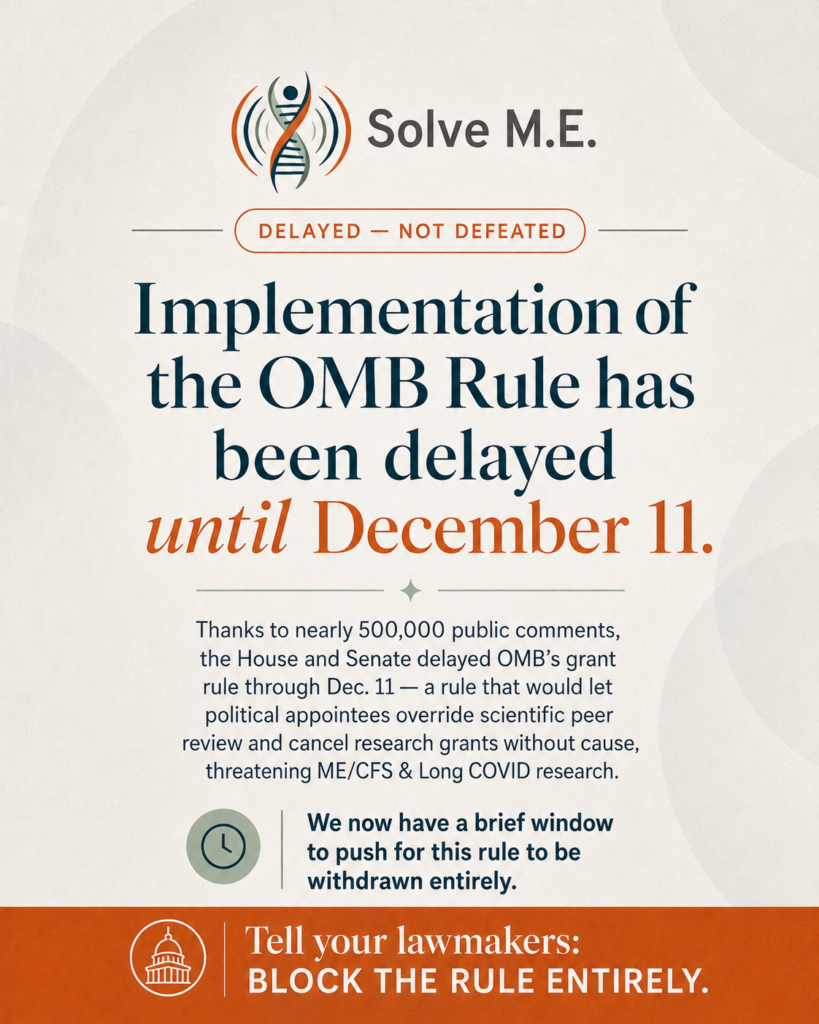
An update from Solve ME - a proposed regulation which would reshape how federal research in the USA is funded has been delayed until Dec. 11.
"We Won a Delay on OMB Guidance, Tell Congress to Finish the Job"
 solvecfs.org
USA residents are asked to contact Congress and ask them to withdraw this rule completely.
"We Won a Delay on OMB Guidance, Tell Congress to Finish the Job"
We Won a Delay on OMB Guidance, Tell Congress to Finish the Job - Solve ME/CFS Initiative Regulation for Federal Financial Assistance.
Congress delayed the OMB rule letting political appointees cancel federal grants. Tell them to end the rule permanently.
solvecfs.org
This delay is a reprieve, not a resolution. As written, this regulatory guidance would:
- Let political appointees override independent scientific peer review, treating expert recommendations as non-binding – replacing scientific merit with political judgment;
- Allow agencies to cancel active research grants at any time when priorities shift, with no finding of wrongdoing required, wasting years of taxpayer investment and abandoning patients enrolled in ongoing studies;
- Restrict researchers from publishing their findings, attending conferences, and even communicating with the patients their work is meant to serve.
USA residents are asked to contact Congress and ask them to withdraw this rule completely.


shak8
Senior Member (Voting Rights)
ChronicallyOverIt
Senior Member (Voting Rights)

Chandelier
Senior Member (Voting Rights)
We have a thread here.I think this is by the same author:
VDAC oligomers form mitochondrial pores to release mtDNA fragments and promote lupus-like disease
ChronicallyOverIt
Senior Member (Voting Rights)
Sounds like this new IVO-21 is very similar to VBIT-4 from that paper

Dolphin
Senior Member (Voting Rights)
From Facebook
Remember that Office of Management and Budget Guidance for Federal Financial Assistance that we are all still pushing back on (we’ve gotten it delayed through December 11th)?
There’s a follow-up action that we need to draw your attention to. The administration is trying to do a lot of the same things to the NIH grant process, utilizing a different mechanism.
For our community, NIH-funded research is the bridge between indefinite suffering and progress on treatments.
Reports this weekend indicate the administration is drafting an executive order that would give an outside committee the power to review NIH grants on political grounds rather than scientific merit.
Giving political appointees the power to override expert scientific review risks shifting funding decisions away from science. It adds new barriers and delays for people living with ME/CFS, Long Covid, and other complex chronic diseases, when they can least afford them.
We appreciate the commitment to spend every NIH dollar, and we're urging that those dollars keep going to the strongest science, chosen on the merits and without new political hurdles. Patients have already waited long enough.
Read our full statement https://ow.ly/pHk350ZPTLT
Want to get involved?
Use our toolkit to contact your Members of Congress and tell them to protect merit-based science at the NIH:


Good stuff, but the call would have more moral authority if Solve was not itself wasting funds on horribly poorly designed trials of gadgets with implausible therapeutic mechanisms.We appreciate the commitment to spend every NIH dollar, and we're urging that those dollars keep going to the strongest science, chosen on the merits and without new political hurdles. Patients have already waited long enough.
Cort Johnson article on IVO-21

IVO-21 - A Paradigm Changer AND a Mitochondrial Drug for ME/CFS? - Health Rising
Could a new mitochondrial drug called IVO-21 be the answer to the energy problems in ME/CFS, fibromyalgia, and long COVID?
www.healthrising.org
ahimsa
Senior Member (Voting Rights)
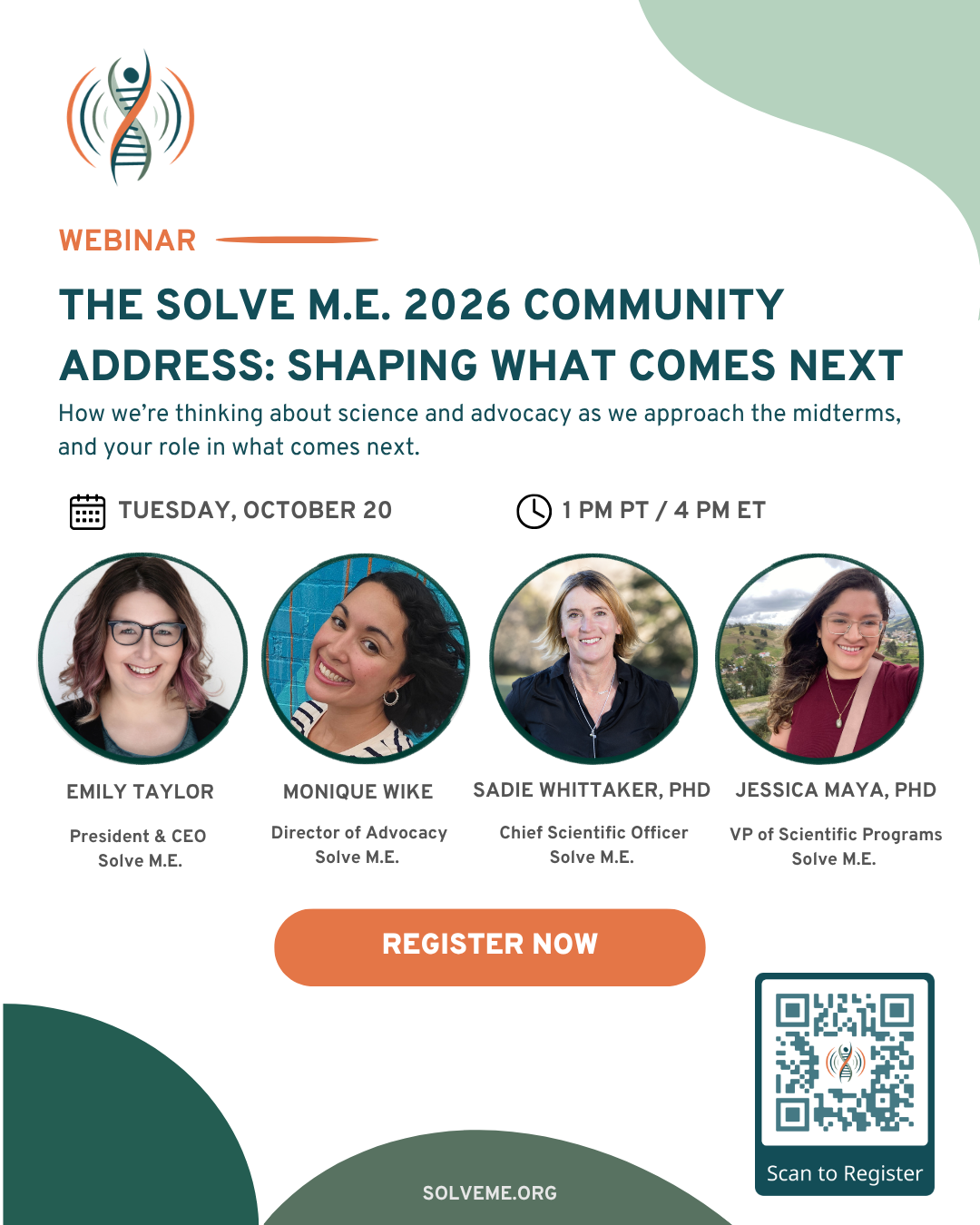
Solve M.E. event scheduled for Monday, October 20, 1 PM PT / 4 PM ET:
"The Solve M.E. 2026 Community Address: Shaping What Comes Next"
 solvecfs.org
Registration link (shows time in your time zone)
"The Solve M.E. 2026 Community Address: Shaping What Comes Next"
The Solve M.E. 2026 Community Address: Shaping What Comes Next - Solve ME/CFS Initiative
Join Solve M.E. on October 20 for the 2026 Community Address, exploring what’s next for ME/CFS research, advocacy, federal funding, and our community.
solvecfs.org
Solve ME said:On October 20th, Solve M.E. is bringing our community together for the 2026 Community Address: Shaping What Comes Next, a live conversation about how we are thinking about science and advocacy as we approach the midterms, and your role in what comes next.
For two years, this community has been playing defense, protecting federal programs and holding the line while research funding and the agencies we depend on were pulled apart. But holding the line was never the goal. With a new Congress ahead, we are planning to make the most of the opportunity to rebuild the research infrastructure this field runs on; and to make sure ME/CFS and associated conditions are part of that rebuild instead of left out again.
Registration link (shows time in your time zone)
ahimsa
Senior Member (Voting Rights)
A recording of this webinar is now available:Solve ME Webinar:
"Your Story, Your Symptoms, Your Data: Discover unhide ®"
Tuesday, September 22
3:00 pm - 4:00 pm PDT
Chandelier
Senior Member (Voting Rights)
From Bluesky:


 solvecfs.org
New funding opportunity for ME/CFS research! Solve is now accepting submissions for their Ramsay Research Grant Program!
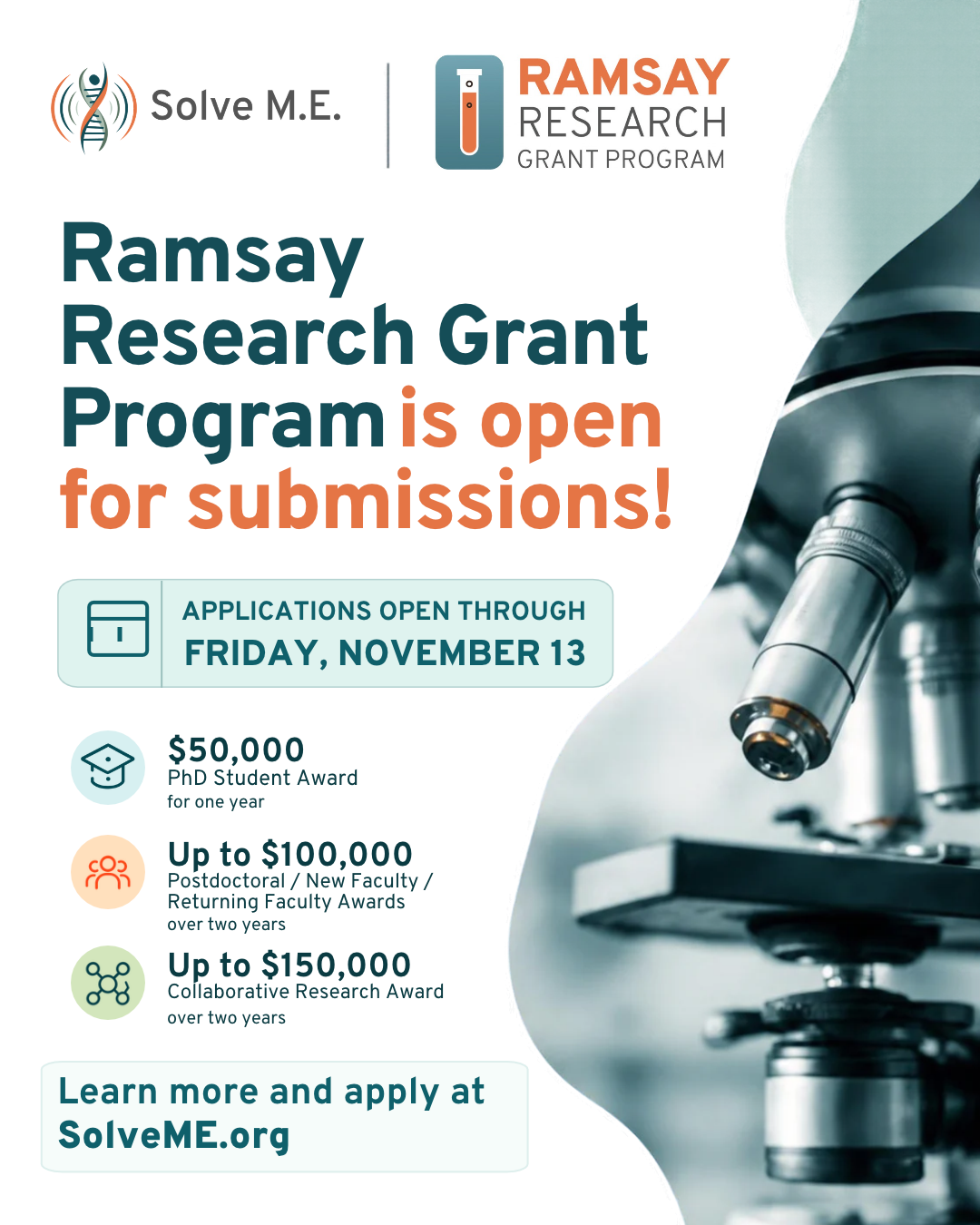
Funding is between $50.000 - $150.000 depending on the category.
The deadline to apply is Friday, November 13, 2026.
2) The funding categories include:
- $50,000 for PhD students for one year
- up to $100,000 for post-doctoral / new faculty / returning faculty for over two years
- up to $150,000 for the collaborative research award over two years
3) The Ramsay Scholars Grant Program uses a two-step application and review process. The Step 1 Research Plan is intended to provide a concise (~ 800 words) overview of the project concept and fit with the Ramsay program.
4) A subset of applicants will be invited to submit a full proposal for double-blind peer review
Applications will receive two independent peer-reviews and will be ranked numerically on a defined scale based on significance, innovation, approach, and overall impact.
5) This second, invite-only stage will start in December with the following dates:
- Invitation to submit full proposal: December 4, 2026
- Full proposal deadline: January 8, 2027
Invited applicants will receive detailed submission instructions and templates.
6) The full request for applications with instructions can be found here:
Proposals should be submitted here:
For any questions, contact Solve at grants@solvecfs.org
7) The Ramsay research program has been quite successful. Since 2016, 36 studies have been supported by the program resulting in 61 publications. It supported researchers such as Scheibenbogen, Wüst, Cambridge, Prusty, Younger, and many others.
Ramsay Research Grants - Solve ME/CFS Initiative
Ramsay Research Grants - Solve ME/CFS Initiative
The Ramsay Program has been successful in attracting new scientists to the field of ME/CFS, providing much-needed funding for researchers to engage with the science of the disease and build pilot data.
solvecfs.org
Last edited:
ahimsa
Senior Member (Voting Rights)
From the Solve ME website:
(I think this is mostly a repeat of info in the previous post but it may include more info)
"Applications Open for 2026 Ramsay Research Grants"
 solvecfs.org
(I think this is mostly a repeat of info in the previous post but it may include more info)
"Applications Open for 2026 Ramsay Research Grants"
Applications Open for 2026 Ramsay Research Grants - Solve ME/CFS Initiative 2026 Ramsay Research Grants for ME/CFS & Long Covid
Applications are open for 2026 Ramsay Research Grants supporting innovative ME/CFS, Long Covid, and infection-associated chronic condition research
solvecfs.org
ahimsa
Senior Member (Voting Rights)
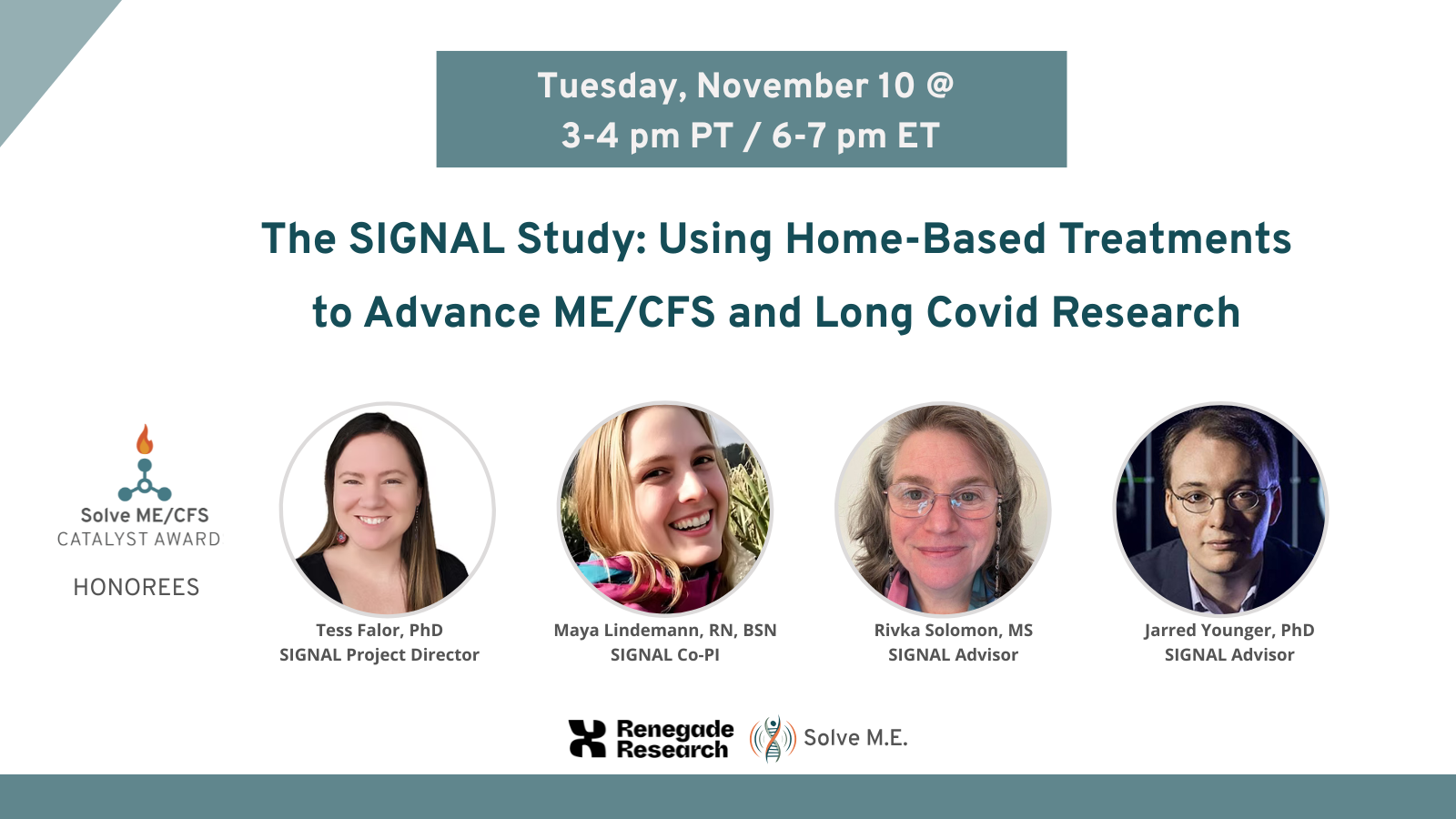
Solve ME Webinar -
"The SIGNAL Study: Using Home-Based Treatments to Advance ME/CFS and Long Covid Research"
Tuesday, November 10
3-4 pm Pacific Time / 6-7 pm Eastern Time
 solvecfs.org
Registration link
"The SIGNAL Study: Using Home-Based Treatments to Advance ME/CFS and Long Covid Research"
Tuesday, November 10
3-4 pm Pacific Time / 6-7 pm Eastern Time
The SIGNAL Study: Using Home-Based Treatments to Advance ME/CFS and Long Covid Research - Solve ME/CFS Initiative
Sign up for our webinar exploring the SIGNAL project, which uses patient data collected via therapeutic devices made available to people with ME/CFS and Long Covid via a lending library.
solvecfs.org
Solve ME said:What if we could learn faster which ME/CFS and Long Covid treatments work—and who they work for? Join members of the SIGNAL research team for a conversation about their Solve ME/CFS Catalyst Award-winning study using real-world patient data to evaluate promising therapies for people with ME/CFS and Long Covid.
The SIGNAL project is built around a device lending library through which people diagnosed with ME/CFS and Long Covid may borrow promising therapeutic devices, shipped directly to their homes at no cost, for a three-month lending period. While borrowing, participants contribute standardized longitudinal data through the Brain Inflammation Collaborative’s (BIC) unhide® online health and research platform. This allows each lending cycle to be a real-world research opportunity.
In this webinar, we’ll hear from Renegade Research team members–scientists and people living with ME/CFS and Long Covid–as they discuss the study’s goals, its patient-centered design, how results will be shared quickly to help patients, clinicians, and researchers make more informed decisions, and how you can get involved.
Registration link