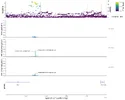
Genetics: Chromosome 17 CA10

I did the same analysis as for the chr20 region. Finemapping with Susie gave a credible set with 64 SNPs that is hard to reduce to a smaller number: the probability is spread out across these SNPs. CA10 is the only protein-coding gene nearby but a lncRNA called ENSG00000310017 falls inside our SNP region but this isn't where the highest probability lies.
1792671632874.webp


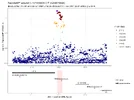
The Encode chromatin data from SCREEN includes 10 regulatory elements with at least one of the 64 SNPs from our ME/CFS credible set. And these 10 are mostly exclusively open in brain tissue with top hits for the cerebellar cortex and spinal cord (although caveat: there were only a limited number of samples in these categories compared to cortex or other tissue). I’ve tried to group them into my own-made categories in the plot below. On the left you see the 10 cCREs (candidate cis-regulatory elements) with the SNPs that fall inside them. Higher z-values means more regulatory activity.

1792671612225.webp

I also looked at the Li 2023 brain atlas which differentiates per cell type in the brain. The ME/CFS SNPs were mostly open in glutamergic Intratelencephalic (cortical layer 2 to 6) cell types.

1792671707492.webp

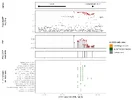
Here’s another plot that puts a lot of info together.
1792671720805.webp
 
Finemapping with Susie gave a credible set with 64 SNPs that is hard to reduce to a smaller number: the probability is spread out across these SNPs

Nice. A few weeks ago I tried adding various Bayesian priors to SUSIE as described in this paper (the method is called PolyFun). PolyFun overweights genetic variants that have S-LDSC annotations associated with a large amount of heritability. The first PIP plot below uses a uniform prior (i.e. standard SUSIE, which should be similar to your results). The second and third PIP plots use different versions of the PolyFun prior. They upweight a few variants annotated as "evolutionarily conserved". The logic is that variants conserved by evolution are typically important, and so tend to carry disproportionate heritability in disease GWAS.

The PolyFun paper provides experiments indicating that on average over many loci, use of this kind of annotation-based prior improves fine-mapping accuracy. However, there is no guarantee that a PolyFun prior is better than the uniform prior on any individual locus.

1792676373694.webp


I wrote up the results here.
 
Sorry, I can only dip into this stuff briefly, I don't follow much of it, so will be blundering.

I was interested to know what the DNase and H3K27ac headings were for in @ME/CFS Science Blog's post in the second figure in #141. I see that they are both markers of the SNP activity, I think with the former indicating chromatin accessibility (unpacking the wrapping around DNA) and histone acetylation (making the SNP chemically ready for transcription, and so being correlated with gene expression).

Do the differences in the results for each measure tell us something useful? If the H3K27ac results aren't suggesting transcription, but the DNAse results suggest the chromatin is accessible in the named tissues, what does that mean?

Also, I guess the two measures for SNPs are for expression in the tissues of healthy people? I guess the DNAse and H3K27ac data could be quite different in ME/CFS tissues (and indeed it would be really interesting to know if it is different)?

Thanks for any corrections/clarifications.

Edit: my ongoing state of being enormously impressed by what members can do should be taken as a given. Thanks for the analysis ME/CFS Science Blog
 
Last edited:
Do the differences in the results for each measure tell us something useful? If the H3K27ac results aren't suggesting transcription, but the DNAse results suggest the chromatin is accessible in the named tissues, what does that mean?
H3K27ac is typically considered an "active enhancer" mark (all enhancer regions tend to have H3K4me1, and the subset of active enhancers have both). An enhancer region that is accessible but not active is often called "poised" for this reason. Just as enhancer regions are often cell-type specific, they can be context-specific too. So they might become active under conditions that simply aren't present when these assays were done, like during infection or when the cell is under oxidative stress or something like that.
 
Predictions
The AlphaGenome gave no valuable results or insights.

eQTL
Also, no real matches in the eQTL datasets. The best I found for CA10 was a weak signal in serotonergic neurons (PP.H4 = 0.365, lowest p = 1.7e-3). It does give some info about the direction of effect. If this signal is to be trusted, it suggests that the ME/CFS risk alleles increase CA10.

1792768913974.webp


Phewas
The Phewas however, lots of hits that colocalize with the DecodeME data. I’ve attached the results in the Excel file. I see several categories in them:
  • COGNITIVE SPEED: Reaction time (PP.H4 = 0.96), Duration to first press of snap-button (0.96), Mean time to correctly identify matches (0.95), etc.

  • PAIN: Pain (0.97), Medication for pain relief (0.95), General pain factor (0.93), a new fibromyalgia GWAS probably also colocalize but the full data isn’t’ available yet.

  • GUT: Irritable bowel syndrome (0.94), Gastroesophageal reflux disease (0.97), diseases of the esophagus (PP.H4 = 0.90), etc.

  • SLEEP/FATIGUE: Frequency of tiredness / lethargy in last 2 weeks (0.92), Getting up in morning (0.96), Restless legs syndrome (full data not available but probably colocalizes).

  • OVERALL HEALTH: Frailty (0.96), Overall health rating (0.94), Number of self-reported non-cancer illnesses (0.94), etc.

There are various other traits (time watching TV, high blood pressure, chewing tobacco, etc.) that do not form a patter and might be due to selection bias or big GWAS that have countless signals.

1792769111304.webp
 

Attachments

I think the gut diseases like IBS are interesting because CA10 isn’t expressed in the gastrointestinal tract. So that likely points to the specific neurons linked to the stomach and gut being involved in these diseases through CA10 (over?)expression. On the other hand, it’s interesting that autism or schizophrenia don’t show up at the top of our list despite having a known connection to neurexins.

It looks like CA10 helps delivery of neurexins to the surface to form synaptic connections. On the other hand, its binding blocks the heparan sulfate (HS) binding to e.g. LRRTM2. So, the overall effect is probably to increase non-HS binding to things we haven’t fully identified yet. It seems to be a pathway that is more relevant to fibromyalgia, IBS, ME/CFS and possibly than for autism, schizophrenia and other psychiatric disorders.

CA10 is mostly expressed in the cerebellum and to a lesser extent in the cortex. The chromatin data of the ME/CFS hit pointed to Intratelencephalic (IT) neurons.
1792769243808.webp
 
A well known habit common to all people with ME/CFS. Now where did I put that blasted spittoon?
The only time healthy ever felt something vaguely similar to the “must be completely flat, high vertigo, brain not responding” state I get in crashes at very severe, is when I took a very strong snus whilst having approximately 0 nictine tolerance. (Probably tangential, idek if snus counts as chewing tobacco)
 
H3K27ac is typically considered an "active enhancer" mark (all enhancer regions tend to have H3K4me1, and the subset of active enhancers have both). An enhancer region that is accessible but not active is often called "poised" for this reason. Just as enhancer regions are often cell-type specific, they can be context-specific too. So they might become active under conditions that simply aren't present when these assays were done, like during infection or when the cell is under oxidative stress or something like that.
1792671612225.webp
So, the regions that are accessible (as indicated by red in the DNAse left hand column) in a tissue but don't have the switch marked to "on" for transcription (as would be indicated by red in the H3K27ac right hand column) are "poised" to become active, perhaps under a condition created by exertion (e.g. sustained firing of neurons).

And, I think all this has to be interpreted knowing that this tissue expression information has been produced by assays on both healthy tissue and non-healthy tissue like cancer cell lines. So, for some regions, there could be a level of uncertainty about the information, even for healthy people. And, we mostly don't know what the actual situation is for people with ME/CFS. It could be that ME/CFS is a state of having tissue somewhere being unusually poised for transcription.
 
It could be that ME/CFS is a state of having tissue somewhere being unusually poised for transcription.
I agree that there's a lot of uncertainty in the chromatin and histone mark data (the databases are still too small and don't cover enough situations and context), but genetics mostly point to risk factors. So it's about how you get ill when you don't have ME/CFS yet. And these genetic hits all have mutations that are common in the general population and cause only tiny changes in biology. So looking at samples from healthy people isn't a bad proxy for trying to understand what biological pathways they impact.
 
Back
Top Bottom